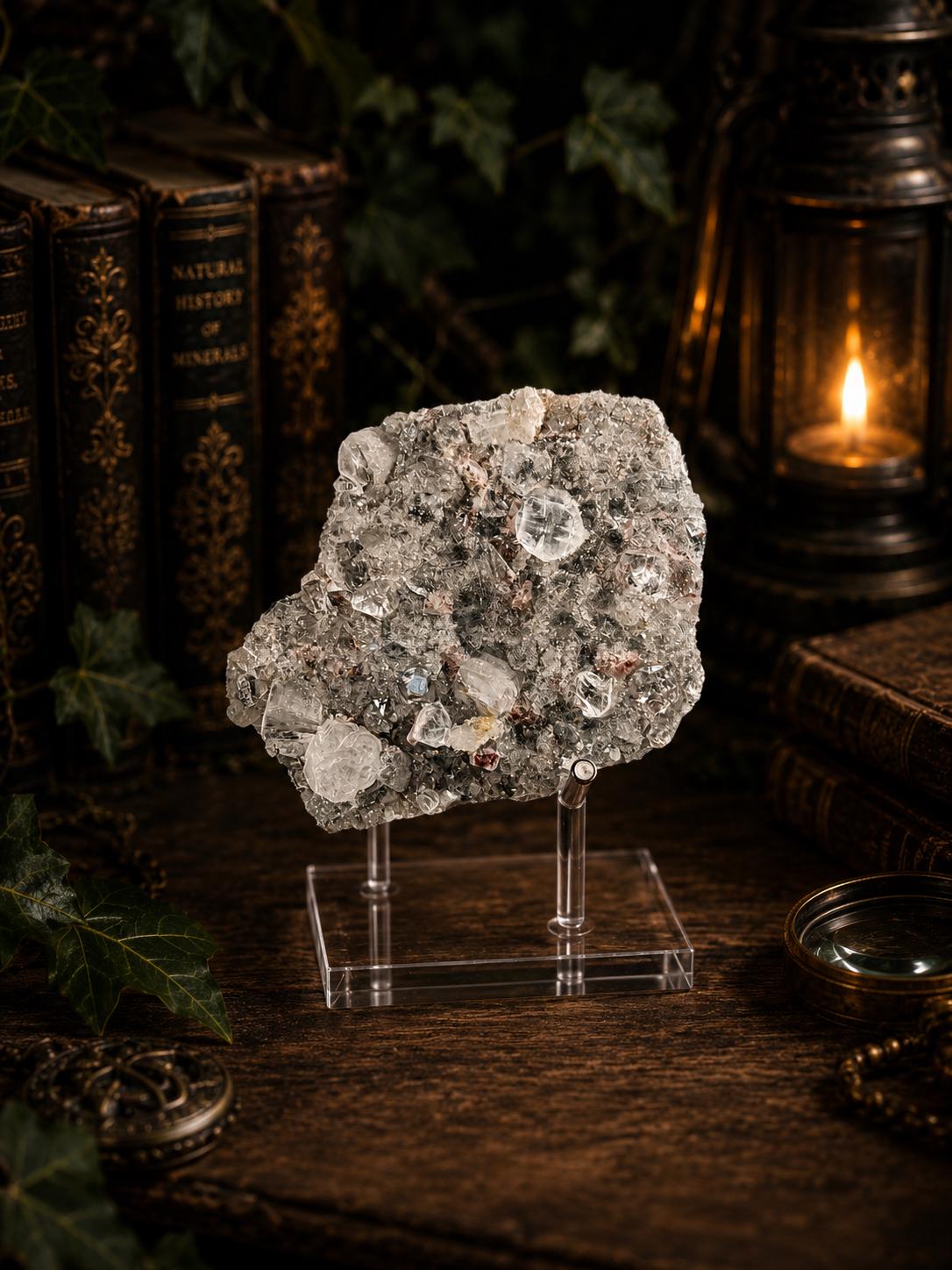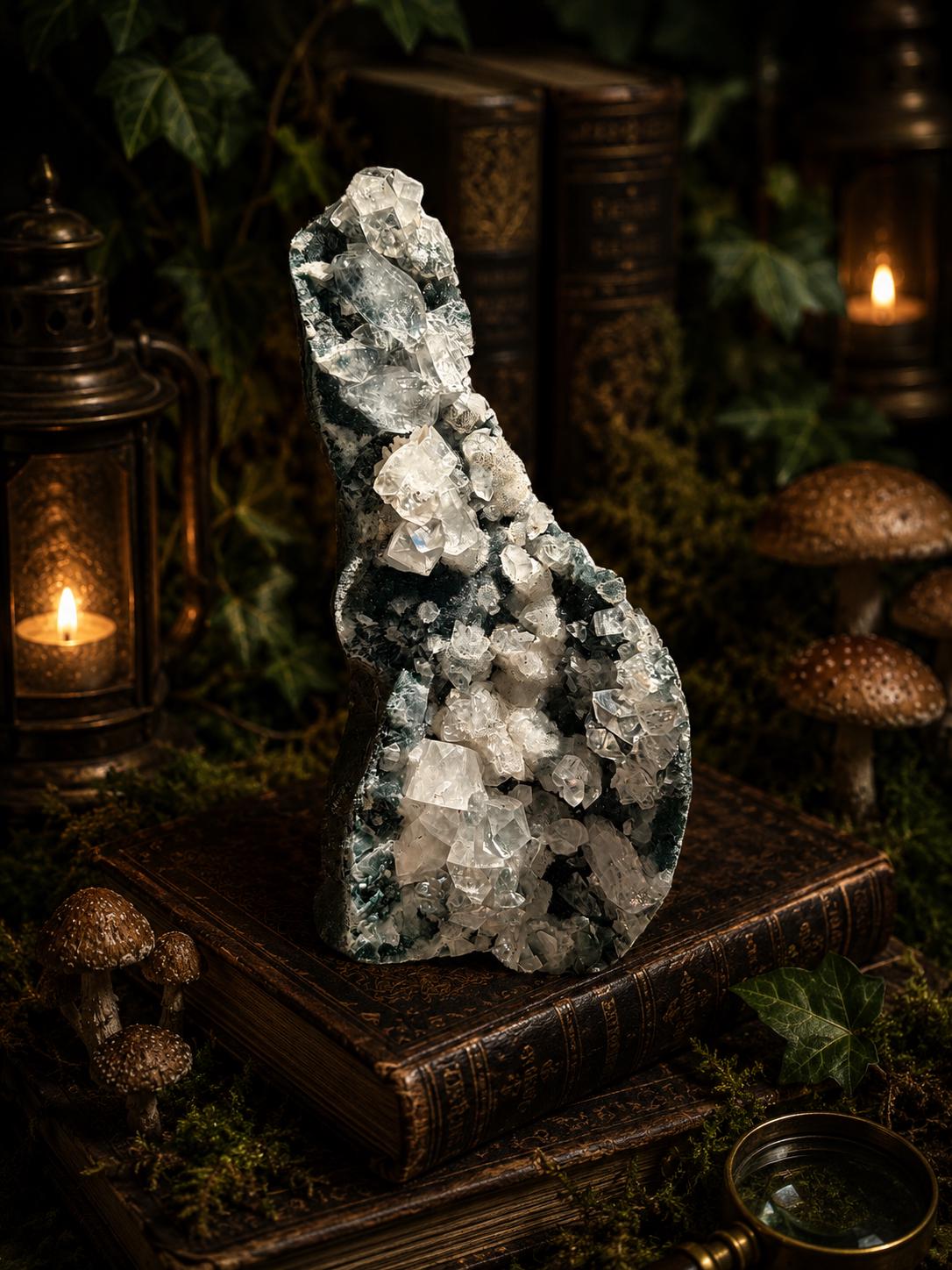
Apophyllite grows glassy pyramid-tipped crystals with an almost supernatural sparkle — its internal structure reflects light so completely that clusters seem lit from within. Nearly all the fine specimens in the world come out of the volcanic basalts of India’s Deccan region, where they’ve been crystallizing in stone hollows since those lava flows cooled.
Traditionally it’s associated with mental clarity, deep calm, and spiritual awakening — a favorite meditation-shelf stone, said to make a room feel lighter just by sitting in it. Mine live on custom stands so all those tiny faces can do their work.
How apophyllite forms
Apophyllite is a child of old lava. When the immense basalt flows of India’s Deccan Traps cooled — one of the largest volcanic events in Earth’s history — they left countless gas pockets behind, and over the ages mineral-rich water furnished those hollows with crystals. Apophyllite is the star tenant: glassy, pyramid-tipped crystals of potassium, calcium, silica, and a little fluorine, holding water inside their structure like a secret.
Its sparkle is structural. The crystal’s faces are glassy, but its base cleaves with a pearly, mirror-like luster — so light enters, ricochets, and pours back out. A good cluster under a lamp behaves like it has its own filament. Quarrymen around Pune uncover the world’s finest, from water-clear to a mint green that collectors chase for decades.
A little history & folklore
The name is a warning label in Greek: apo phyllon, “leafs off,” because heated apophyllite flakes apart in layers as its water escapes. Described scientifically in the early 1800s, it spent its first two centuries as a mineral-cabinet darling before modern crystal tradition adopted it — enthusiastically — as a meditation stone.
That tradition is young but consistent: apophyllite is spoken of as a bringer of light and calm, a crystal for clearing mental fog and (in the more mystical registers) connecting with higher guidance. I’d add the practical observation of every collector: put one where afternoon light lands and the room genuinely changes.
Working with apophyllite
Traditionally apophyllite is associated with clarity, serenity, and awakening — the stone equivalent of opening a window in a stuffy room. How I use it:
- On the meditation shelf or reading corner — its whole tradition is about clearer, quieter attention.
- Where light hits: windowsill (a gentle one), under a lamp, near candles. This stone earns its keep visually in a way few others do.
- Paired with celestite for the full serenity register, or clear quartz — the two great light-keepers, side by side.
My apophyllite specimens are one-of-a-kind on custom stands — countless tiny faces, all of them generous.
Caring for your apophyllite
☾ Softer than quartz and its points are delicate — no tumbling with rough company, no long soaks, and it prefers shade to hot sun. A soft brush for dust and a moonlight bath keep the sparkle honest.