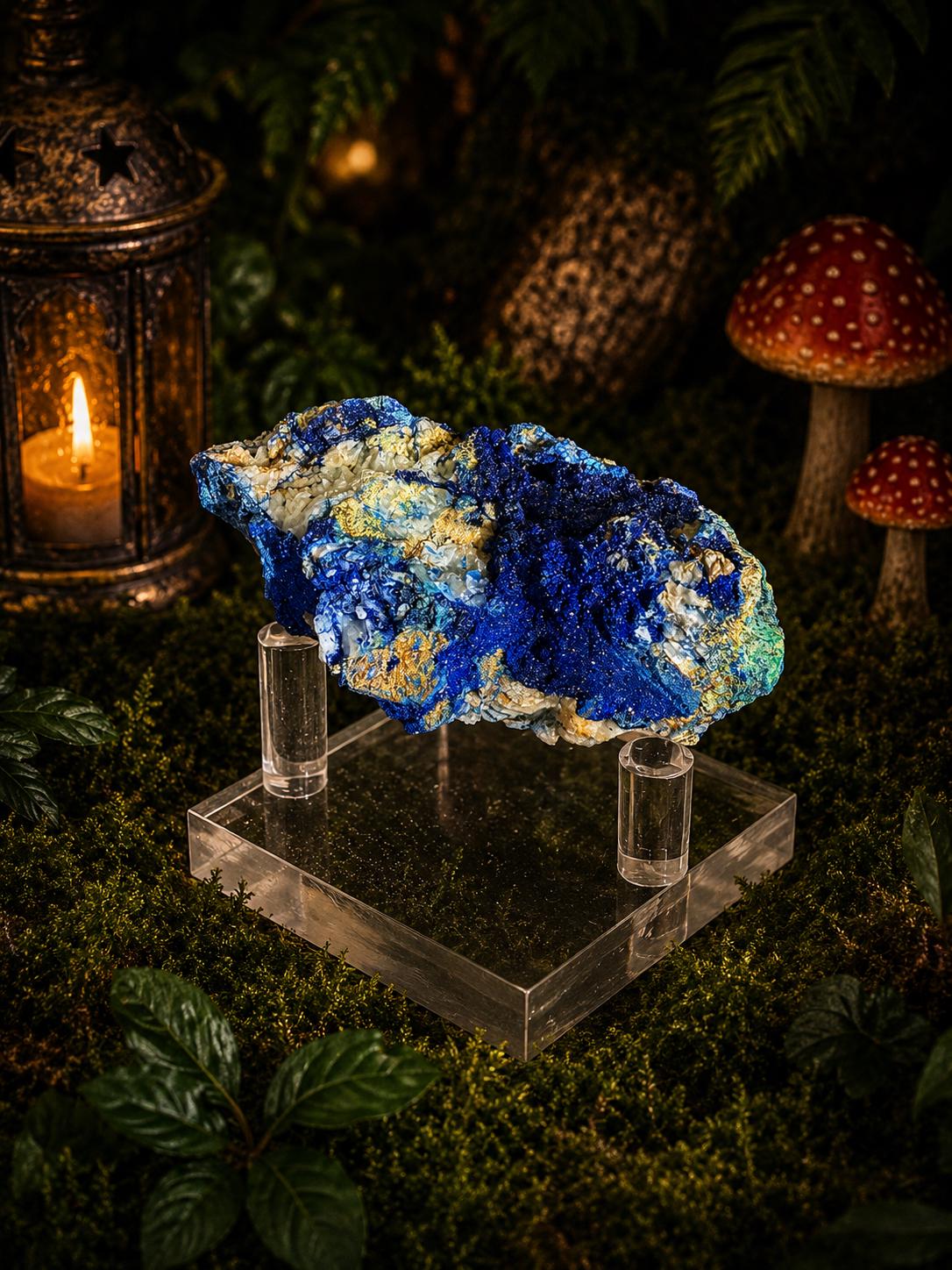
Azurite is copper caught mid-transformation — a deep electric-blue carbonate that forms where copper deposits weather and breathe. Ground into pigment, it painted the skies of medieval manuscripts and Renaissance panels; given enough centuries, it slowly transforms into green malachite, which is why some old painted skies have quietly turned green. A stone that literally changes its mind.
Traditionally azurite is associated with insight, intuition, and clear inner vision — old lore calls it the stone of heaven. Mine is a raw specimen on a clear stand, all velvet-blue druzy texture.
How azurite forms
Azurite is what copper does when it weathers beautifully. In the oxidized upper zones of copper deposits — where ore, water, and carbon dioxide negotiate — copper recombines into a carbonate of impossible blue, crusting cavities in velvet druzy or blooming into rosettes. It keeps famous company: azurite and green malachite form in the same zones and often in the same specimen, blue and green marbled like the Earth seen from orbit.
And the relationship runs deeper: azurite is actually the less stable of the two. Given moisture and geological patience, it transforms into malachite while holding its crystal shape — a mineral ghost story called pseudomorphism. Every azurite specimen is a moment the earth has agreed, temporarily, to hold.
A little history & folklore
Azurite’s history is painted — literally. Ground fine, it was the great affordable blue of medieval and Renaissance Europe, coloring manuscript heavens and altarpiece skies (some of which, centuries on, have quietly turned green as the pigment continued its patient journey toward malachite). The ancients mined it at Chessy in France so notably the stone was long called chessylite, and Namibia’s Tsumeb mine and Arizona’s copper country produced the specimens museums brag about. The name shares a root with azure itself, by way of Persian lazhward — the old word for that whole family of precious blues.
In modern tradition azurite is the stone of heaven — associated with insight, intuition, and seeing into things: the specialist’s stone for study, dreamwork, and the third eye.
Working with azurite
Traditionally azurite is associated with vision in every sense — insight, intuition, understanding what’s beneath the surface. How I use it:
- On the study desk or beside the journal — its lore is all about the aha.
- As a contemplation piece: that blue is not a color you glance at; it’s a color you fall into for a minute and come back calmer.
- Paired with labradorite for full inner-vision energy, or clear quartz to keep the insight well-lit.
Mine is a raw one-of-a-kind specimen on a clear stand — museum-grade blue, kitchen-table accessible. Keep it dry and it will out-blue everything you own for a lifetime.
Caring for your azurite
☾ Keep it dry and out of strong sun — azurite is soft, its color can dull with light and moisture, and it should never go in water (and never in drinking elixirs; it’s a copper mineral). Dust gently, cleanse with sound or moonlight.