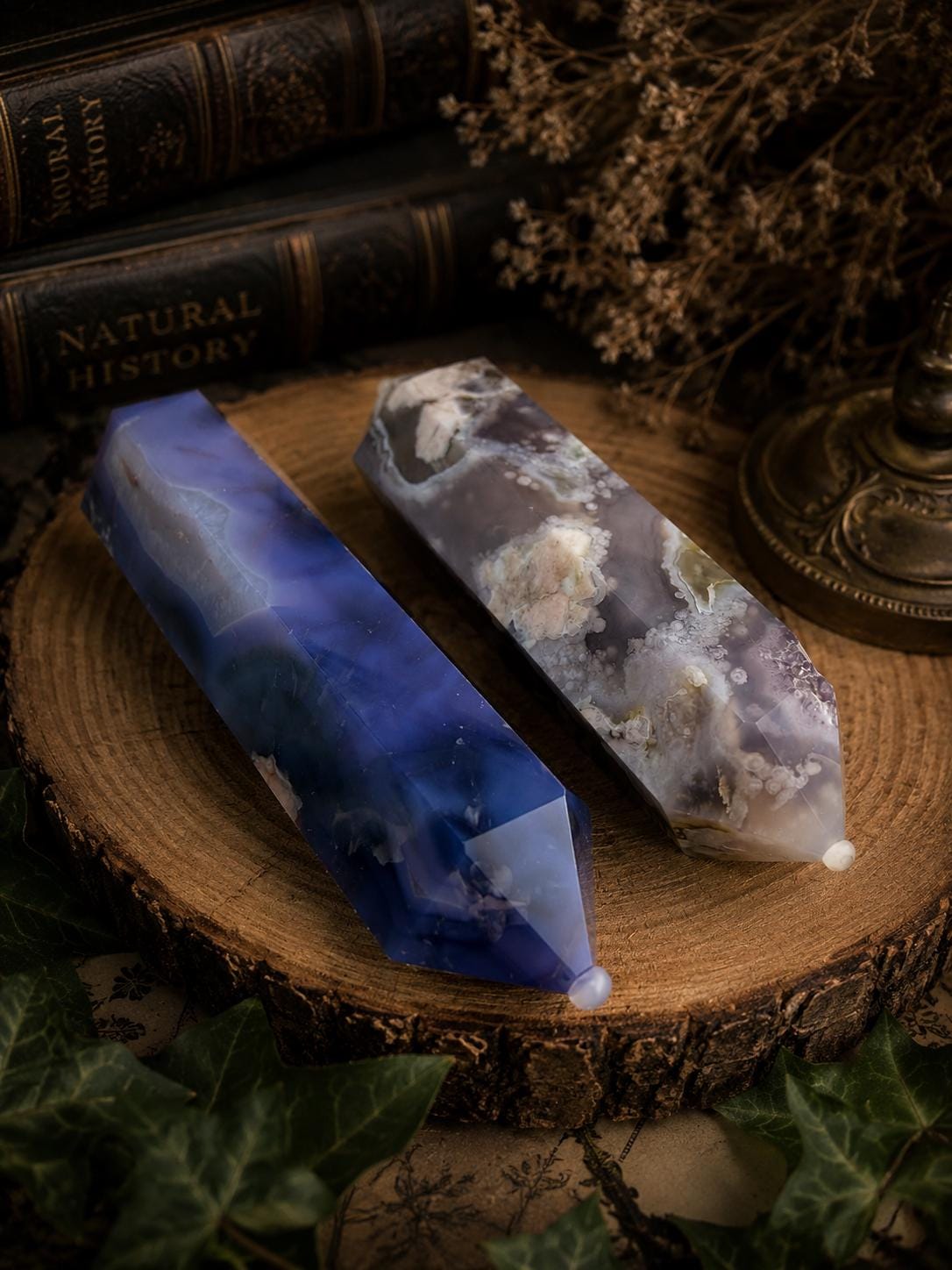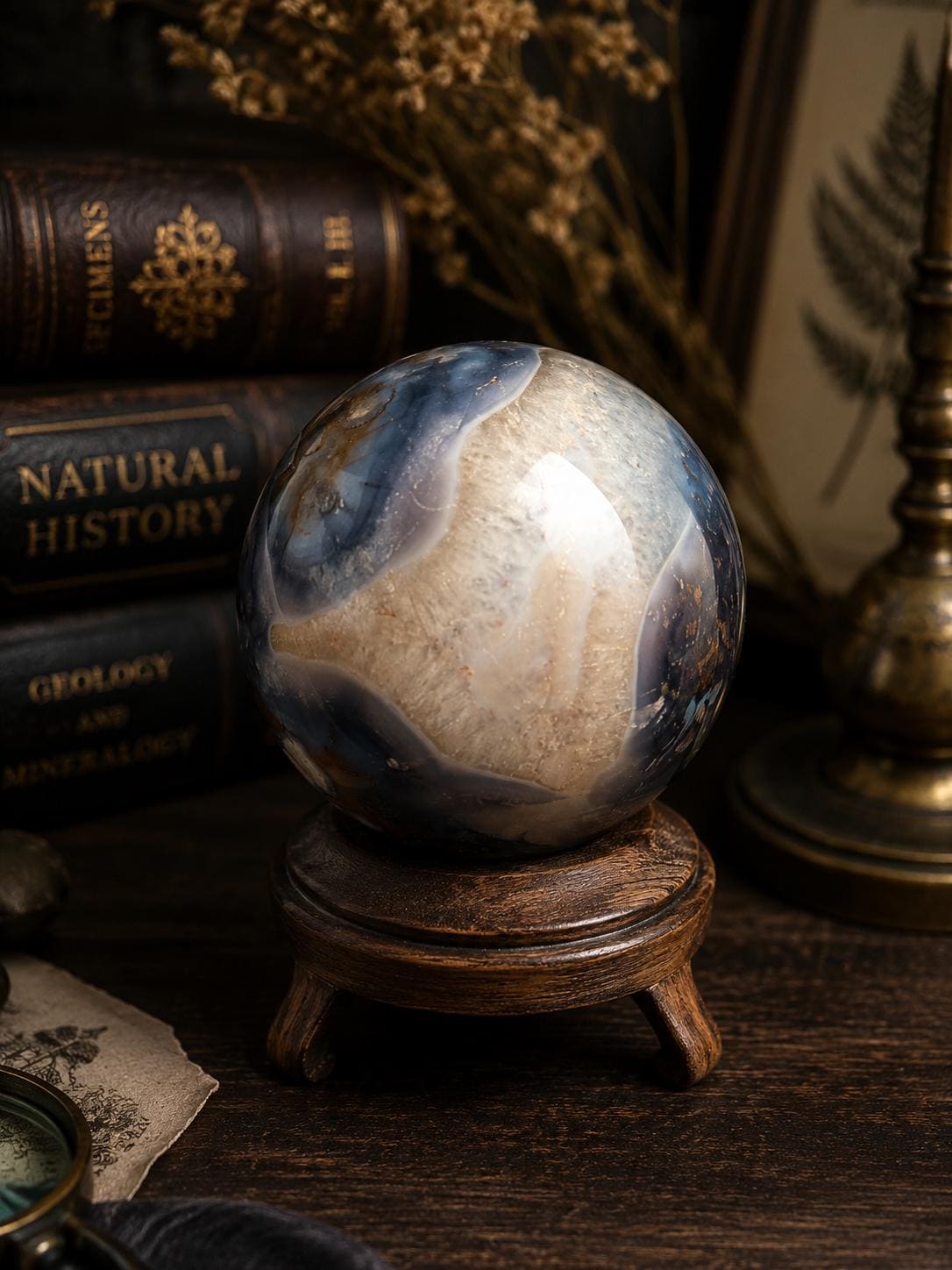
Chalcedony is quartz with the volume turned down — a cryptocrystalline form of SiO₂ whose crystals are far too small to see, which is exactly what gives it that soft, waxy, lit-from-within glow. The blue variety is the one most people mean by the plain word “chalcedony,” a milky powder-blue that reads like fog over water. Humans have carved it since deep antiquity — the Greeks made cameos from it — and the name itself most likely comes from the ancient town of Chalcedon on the Bosphorus.
Traditionally blue chalcedony is associated with calm, kind speech, and the throat — the stone of saying the hard thing gently. I reach for it when I need to communicate from a steady place rather than a raw one.
How blue chalcedony forms
Chalcedony is quartz with the volume turned down. Chemically it’s the same silicon dioxide (SiO₂) as a clear quartz point, but instead of growing one big transparent crystal, it forms as a dense mat of crystals so tiny you can’t see them even with a hand lens — cryptocrystalline, from the Greek for “hidden crystal.” That hidden structure is exactly what gives chalcedony its signature look: not glassy and faceted but soft, waxy, and glowing from somewhere inside, like light through fog.
It grows the way agates and jaspers do — silica-rich fluids seeping into cavities and cracks and slowly filling them, layer by patient layer. The blue variety, the one most people mean when they just say “chalcedony,” turns out a milky powder-blue to blue-grey that reads like early mist over water. It’s a genuinely useful stone to own, too: at 6.5–7 on the Mohs scale it’s tough, water-safe, and stable in the light. No babying required.
Worth knowing: chalcedony is the family name for a whole crowd of stones you already love. Agate, carnelian, onyx, jasper, chrysoprase — all of them are chalcedony wearing different colors and patterns. Blue chalcedony is simply the plain, soft-blue member of a very large family.
A little history & folklore
Chalcedony has one of the oldest human résumés of any stone. It takes its name, most likely, from the ancient town of Chalcedon on the Bosphorus, and archaeological evidence shows people carving it as a gemstone since deep antiquity. The ancient Greeks especially loved the blue and green pieces, cutting them into cameos and seals; Roman signet rings were often chalcedony too, because its fine, even texture takes a crisp engraving.
Its folklore followed its color. A soft, sky-toned stone became, in modern crystal tradition, the great stone of gentle speech — the throat-chakra piece, associated with calm words and the courage to say hard things kindly. That’s an association I find easy to believe just by holding one.
Working with blue chalcedony
Traditionally blue chalcedony is associated with calm, serenity, and kind communication. How I use it:
- Kept near where the hard conversations happen — a phone nook, a desk, a bedside — as a small anchor for speaking gently.
- Held before you have to say something true and tender, when tradition says it helps you speak from steadiness instead of heat.
- Paired with blue lace agate, its close throat-chakra cousin, or larimar when you want the calm-blue energy dialed all the way to serene.
My blue chalcedony pieces are one-of-a-kind and ship with their own Chalcedony spell scroll — soft words, in a soft stone.
Caring for your blue chalcedony
☾ Water-safe and durable (6.5–7 on the Mohs scale). An easy keeper — a rinse is fine, and moonlight or sunlight both suit it; its gentle blue is stable.