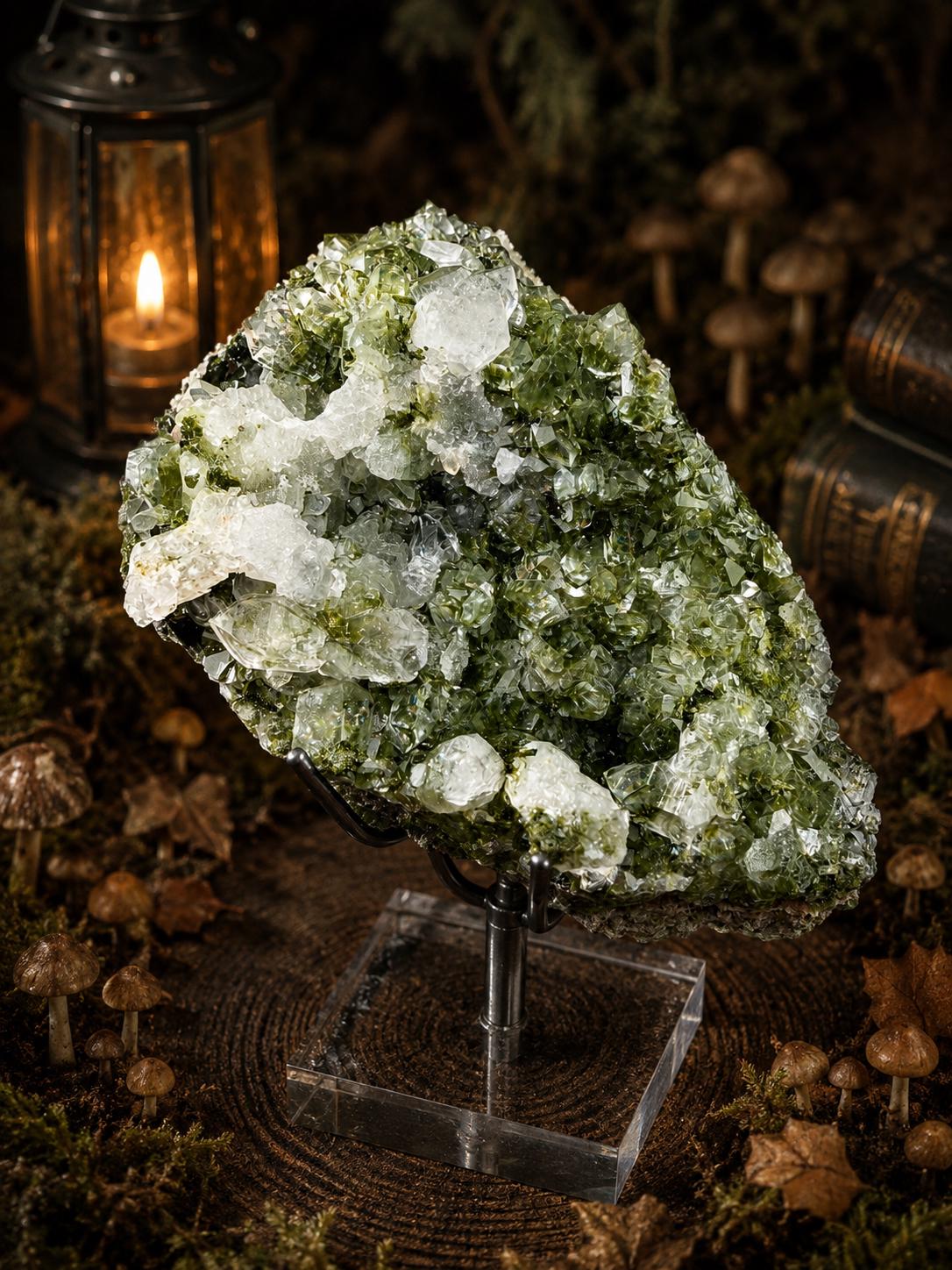
Epidote grows in deep pistachio-green blades and sprays, often tangled with quartz or calcite like undergrowth on a forest floor. Collectors love it for its structure; I love it because it looks like the woods after rain.
It’s traditionally associated with amplifying whatever you bring to it — growth, intention, honest effort. A stone that meets you halfway. Our specimen clusters are one-of-a-kind, photographed exactly as they’ll arrive.
How epidote forms
Epidote is a child of transformation — it crystallizes where rocks are being remade, in the warm, water-rich conditions of metamorphism and hydrothermal alteration. When basalts and other iron-and-calcium-bearing rocks get cooked and steeped, epidote blooms through them in sprays of deep pistachio needles and blades. Its green is so characteristic that geologists use the stone as a field marker: where you see epidote, the earth has been renovating.
Austria’s Knappenwand mine produced the legendary museum crystals — dark, lustrous blades the length of your hand — while Pakistan and Peru supply beautiful modern specimens. In Mali, epidote grows intertwined with prehnite, needles of deep green caught inside sea-glass green, one of my favorite mineral friendships and one you’ll see in my prehnite specimens.
A little history & folklore
Epidote’s folklore begins, unusually, with a measurement. The French crystallographer René Just Haüy named it in 1801 from the Greek epidosis, “increase,” for a quirk of its geometry — one side of the crystal base outruns the other. Modern crystal tradition ran with the name and never looked back: epidote became the stone of increase, said to amplify whatever energy it keeps company with. Gratitude grows; so, allegedly, does grumbling — making epidote the rare stone that comes with a responsibility clause.
I find that tradition genuinely useful, whatever its mechanism: a stone that asks “are you sure you want more of what you’re currently practicing?” is a stone doing philosophy.
Working with epidote
Traditionally epidote is associated with growth, release of old patterns, and amplification of intention. How I use it:
- With a gratitude practice — the stone sits on the journal, the tradition does the rest.
- In the garden or with houseplants, where “stone of increase” can do its most literal work.
- Paired with prehnite — nature ships them together in the same specimens, and their traditions (increase + nurture) were made for each other.
Point it at something you love. That’s the whole instruction manual.
Caring for your epidote
☾ Keep it dry and dust it gently — specimen clusters are for admiring, not tumbling. Sound cleansing is perfect.