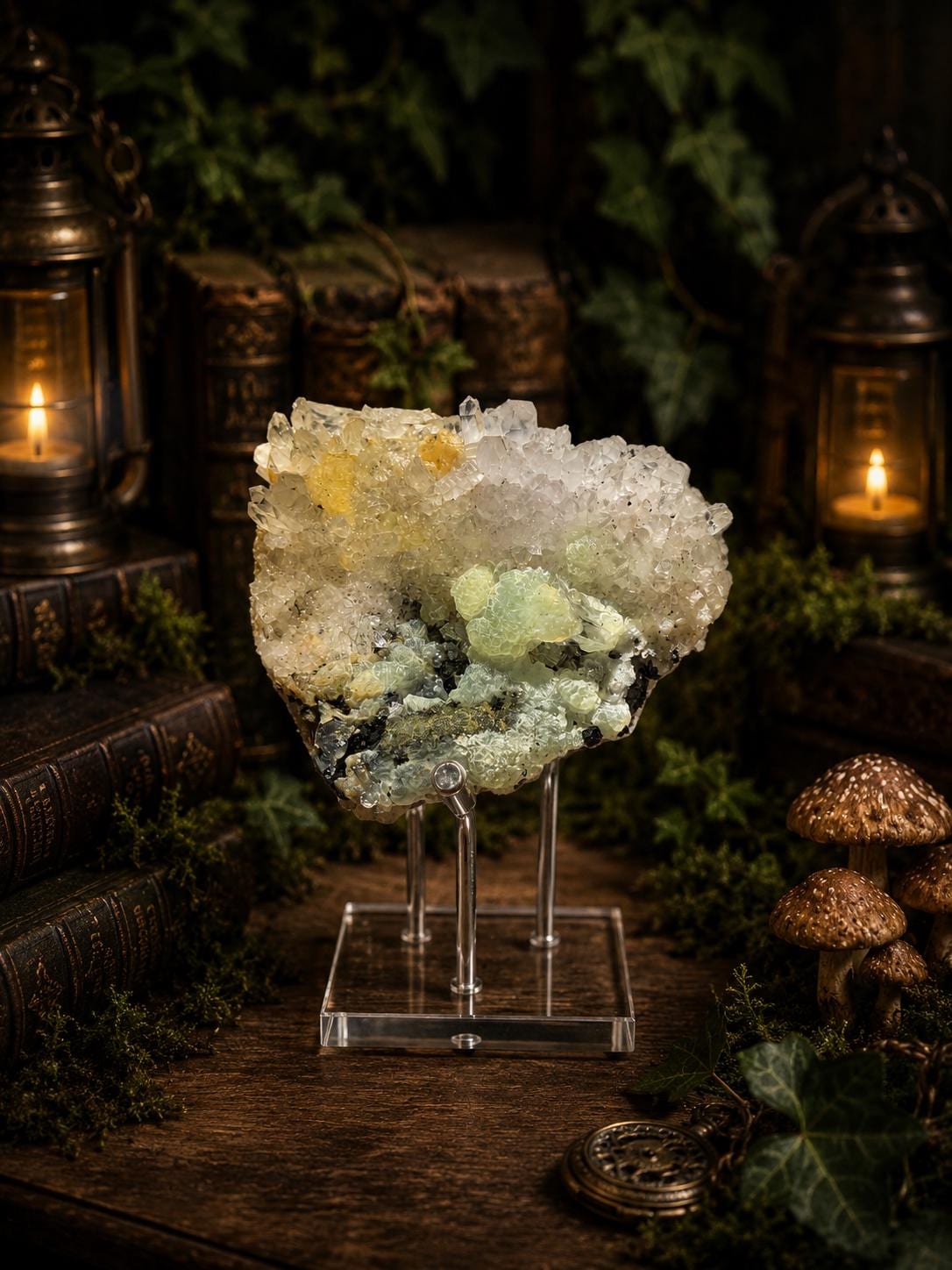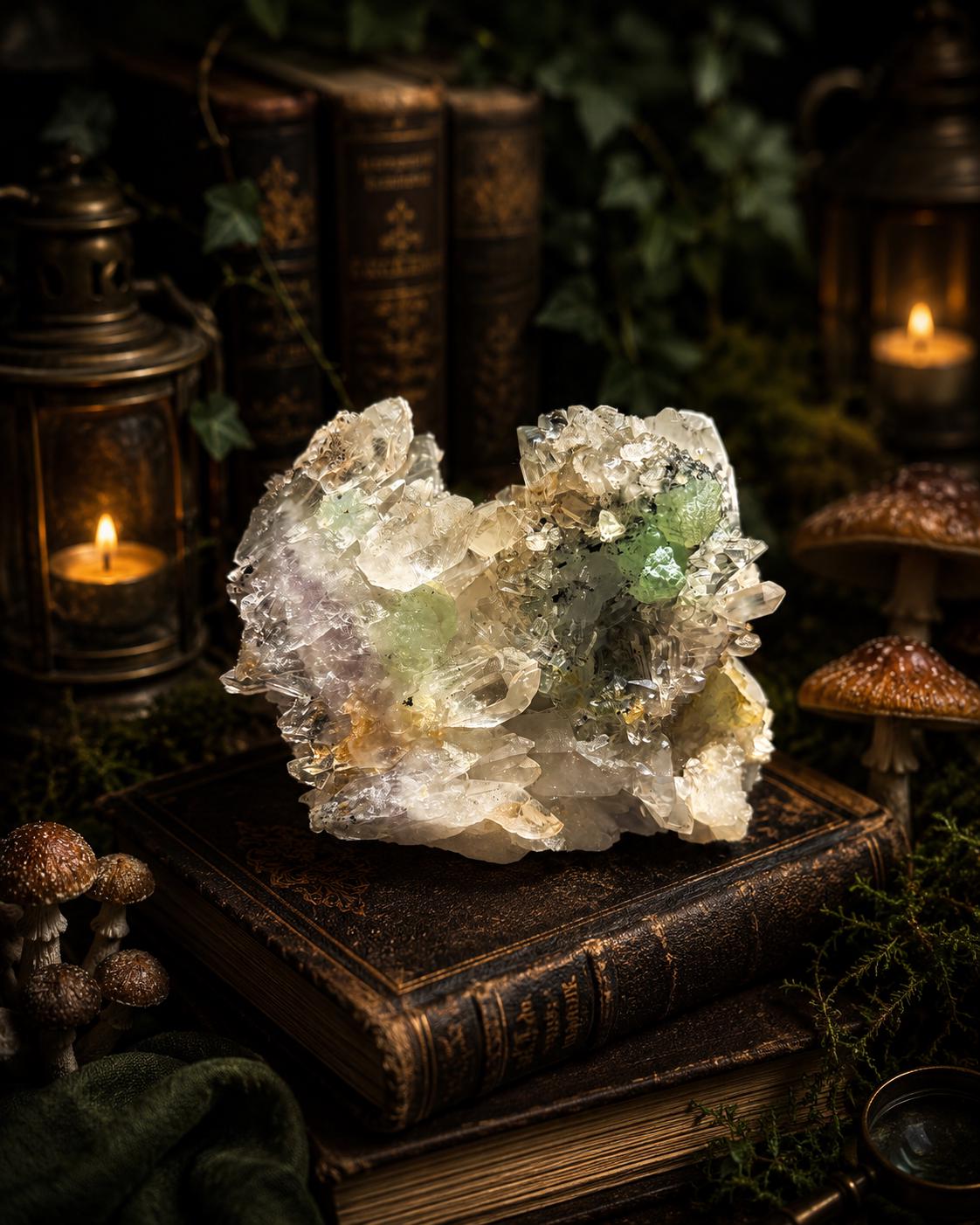
Prehnite holds a quiet little record: it was the first mineral ever named after a person — Colonel Hendrik von Prehn, who brought it back from South Africa’s Cape of Good Hope in the 1780s. It grows in soft botryoidal crusts the color of sea glass and pale spring leaves, often tangled with dark epidote needles, and it seems to glow from the inside when light passes through.
Tradition calls prehnite the stone that nurtures the nurturer — associated with calm, quiet renewal, and trusting what you already know. It’s the stone I recommend to the friend who takes care of everyone else first.
How prehnite forms
Prehnite is born in the same renovation projects as its friend epidote: warm, water-rich alteration of volcanic rock. As basalt flows cool and steep in mineral-laden water, prehnite crystallizes in the cavities — almost never as single crystals, but as soft botryoidal crusts and globes, layer over layer, like candle-wax the color of sea glass. Light doesn’t bounce off prehnite so much as wade into it; the stone has a glow-from-within translucency that no photo does justice.
South Africa provided the original specimens; Australia, New Jersey’s traprock quarries, and above all Mali — where prehnite and epidote grow tangled together in golden-green sprays — supply today’s collectors.
A little history & folklore
Prehnite carries a genuine historical first: described in 1788 from specimens Colonel Hendrik von Prehn carried home from the Cape of Good Hope, it became the first mineral ever named after a human being. Before prehnite, minerals were named for places, properties, or gods; after it, every mineralogist could dream of a stone with their name on it. A quiet green crust from South Africa changed the naming customs of an entire science.
Its modern folklore is unusually specific and unusually kind. Tradition assigns prehnite to the nurturers — calling it the stone that heals the healer, associated with calm, inner knowing, and replenishing the well you keep letting everyone else drink from. Southern African lore is also said to have treated it as a dreaming stone. However the tradition assembled itself, it found the right customer.
Working with prehnite
Traditionally prehnite is associated with gentle renewal, trusting your inner knowing, and caring for the caretaker. How I use it:
- Prescribed (in the fun, non-medical sense) to the friend who is everyone else’s emergency contact — keep it where you decompress.
- Held during quiet evenings as a “your turn now” ritual: tea, lamp, stone, silence.
- Paired with epidote — nature ships them entwined, nurture and increase in one specimen — or rose quartz when self-compassion is the assignment.
My prehnite-on-quartz specimens are one-of-a-kind and ship with the Prehnite spell scroll. If you can’t remember the last time someone took care of you, start here.
Caring for your prehnite
☾ Sturdy enough for gentle handling and a quick rinse. It loves moonlight; a night on the windowsill and it feels like new.