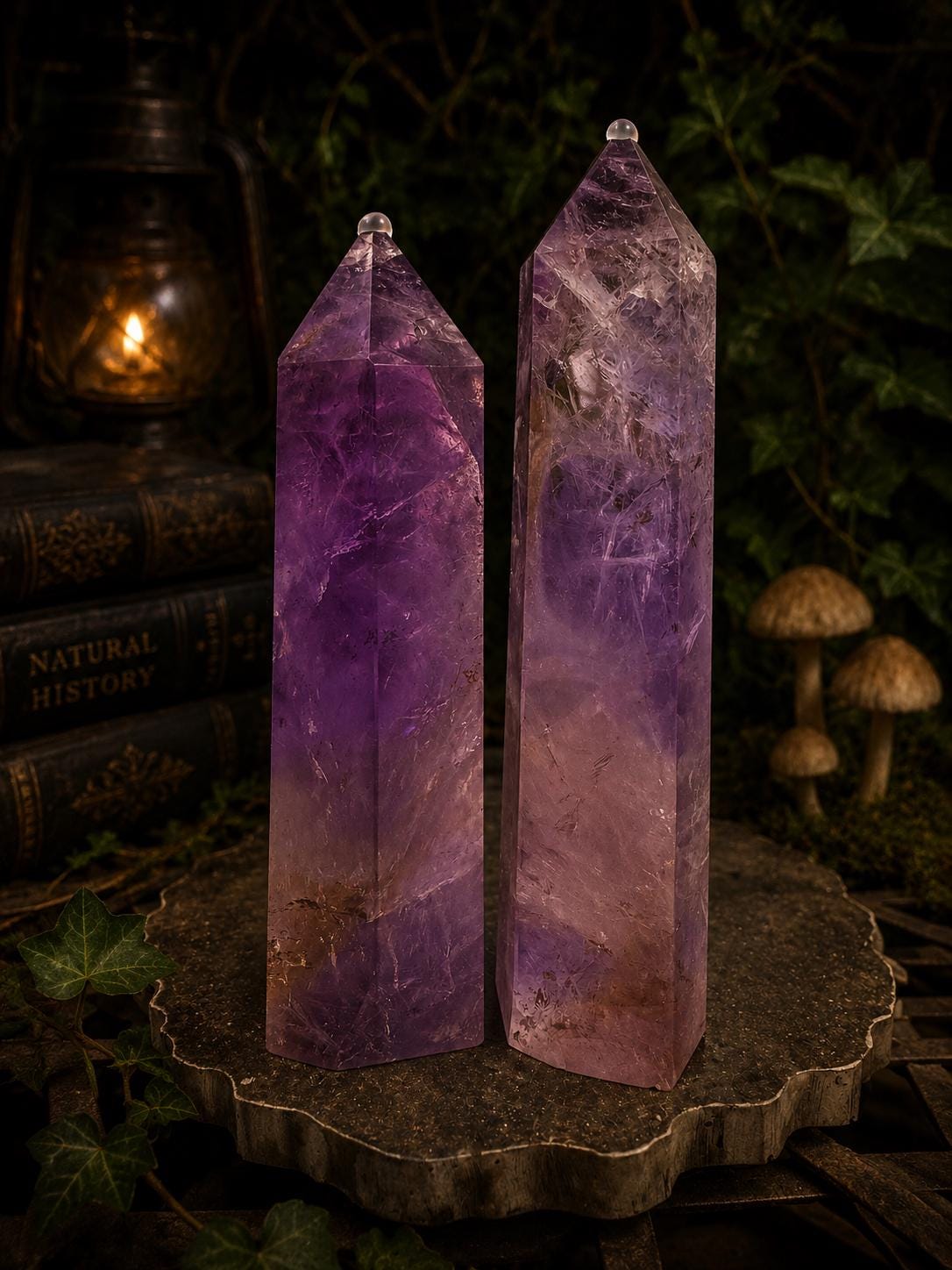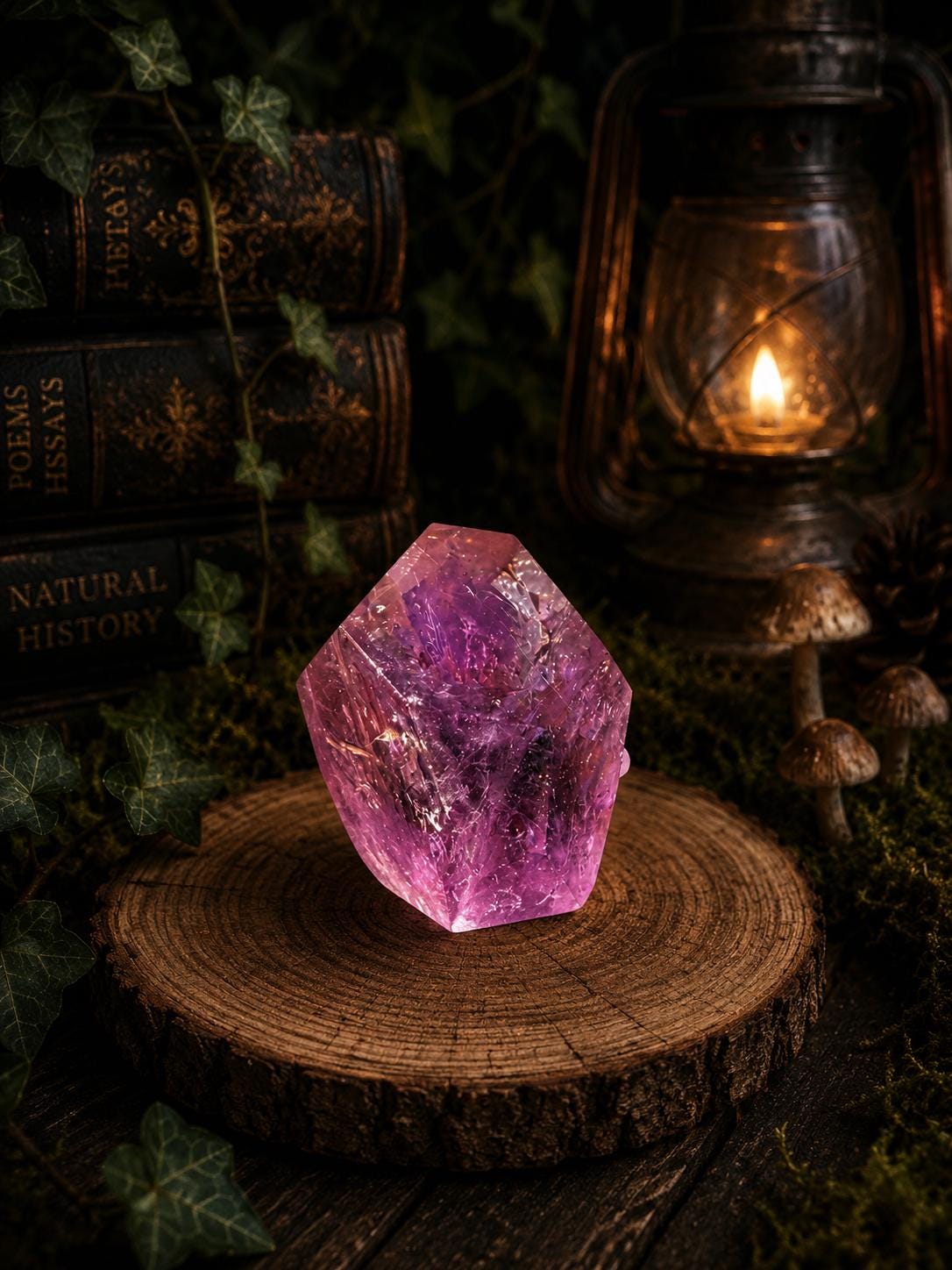
Ametrine is amethyst and citrine grown together in a single crystal — violet and gold in one body, divided by a boundary only the earth understands. The iron inside the quartz oxidized differently in different zones as it formed, so one end cooled into amethyst’s purple while the other warmed into citrine’s honey. Nearly all natural ametrine on earth comes from a single mine — Anahí, deep in the Bolivian wetlands, named for the legend of a princess whose dowry it was.
Traditionally it’s associated with balance and harmony — intuition and willpower, rest and action, moon and sun in the same stone. For anyone holding two truths at once, this is the piece.
How ametrine forms
Every ametrine crystal contains a border no one drew. The stone is single-crystal quartz whose trace iron ended up in two different states as it grew: in some growth sectors the iron was altered the amethyst way, absorbing light into violet; in neighboring sectors it oxidized the citrine way, warming into gold. Geologists credit a delicate temperature gradient during crystallization — the crystal literally grew between two weathers, and kept a souvenir of each.
What makes ametrine near-mythical is the geography: virtually all natural material on earth comes from one place, the Anahí mine, tucked into the Pantanal wetlands of eastern Bolivia and reachable — I love this — mostly by boat.
A little history & folklore
The mine’s story reads like a novel. Legend says a 17th-century Spanish conquistador received the deposit as a dowry when he married Anahí, a princess of the Ayoreo people — and introduced the strange two-colored gem to Europe when he sent pieces home to his queen. The mine then vanished from records for three centuries, rediscovered and formally worked only in the 20th; today it still bears the princess’s name.
Because the stone itself is a peaceful union of two things that usually exist apart, its modern tradition wrote itself: ametrine is the marriage stone, the both/and stone, proof in crystal form that you don’t have to choose.
Working with ametrine
Traditionally ametrine carries both of its parents’ associations at once — amethyst’s calm intuition and citrine’s confident spark — and is reached for wherever balance is the work. My favorite uses:
- On the desk for decisions that need both gut and strategy — hold it with the violet end up when you need to listen, gold end up when you need to act. (Is that in any ancient text? No. Does it work as a focusing ritual? Beautifully.)
- In seasons of transition, as a reminder that two chapters can share one spine.
- Paired with amethyst or citrine when one side of the balance needs reinforcement.
My ametrine pieces ship with their own Ametrine spell scroll — one scroll, two weathers.
Caring for your ametrine
☾ Sturdy quartz — a rinse is fine. But like both of its parents, its colors can fade in prolonged direct sun, so give it moonlight instead.