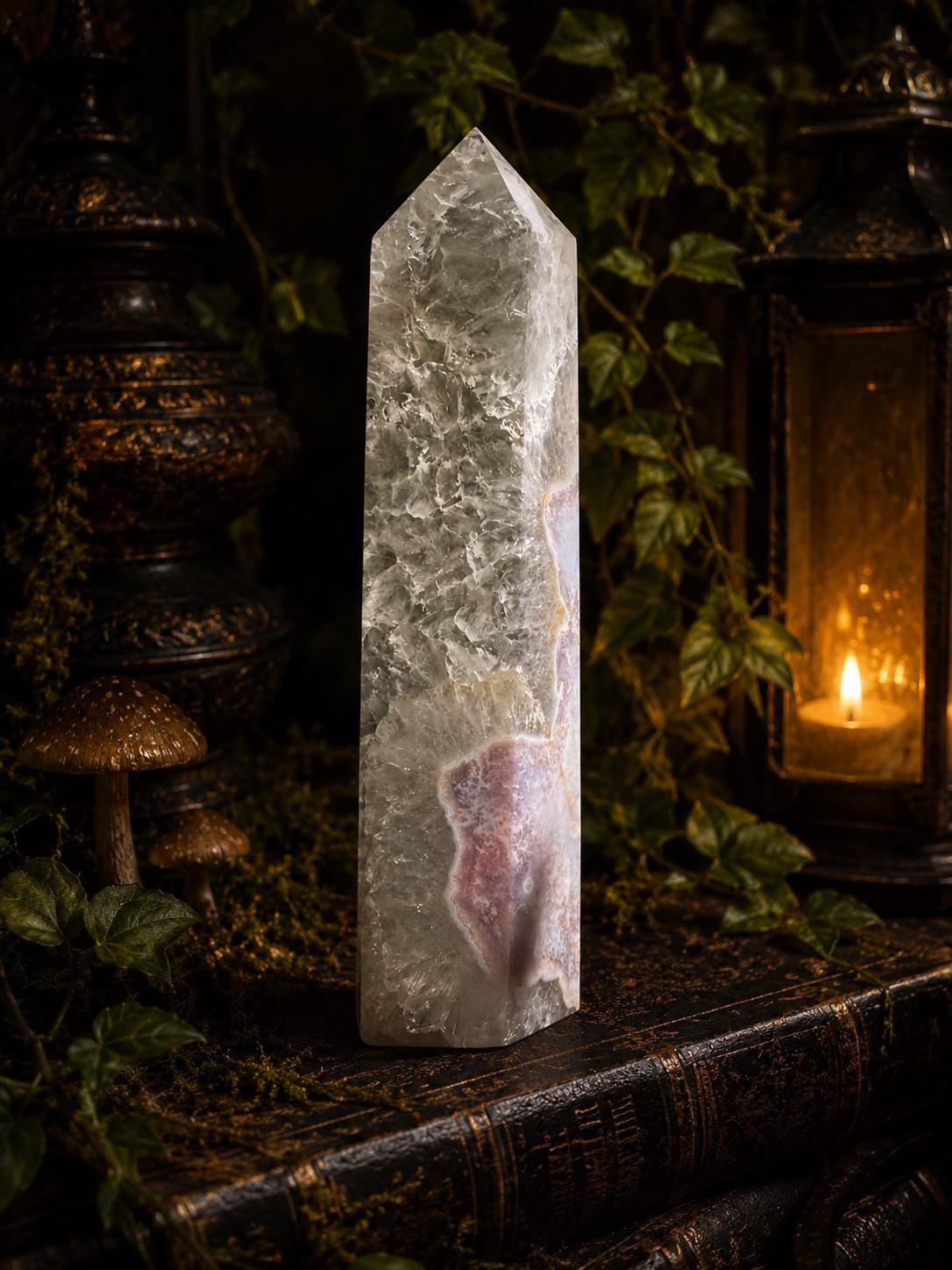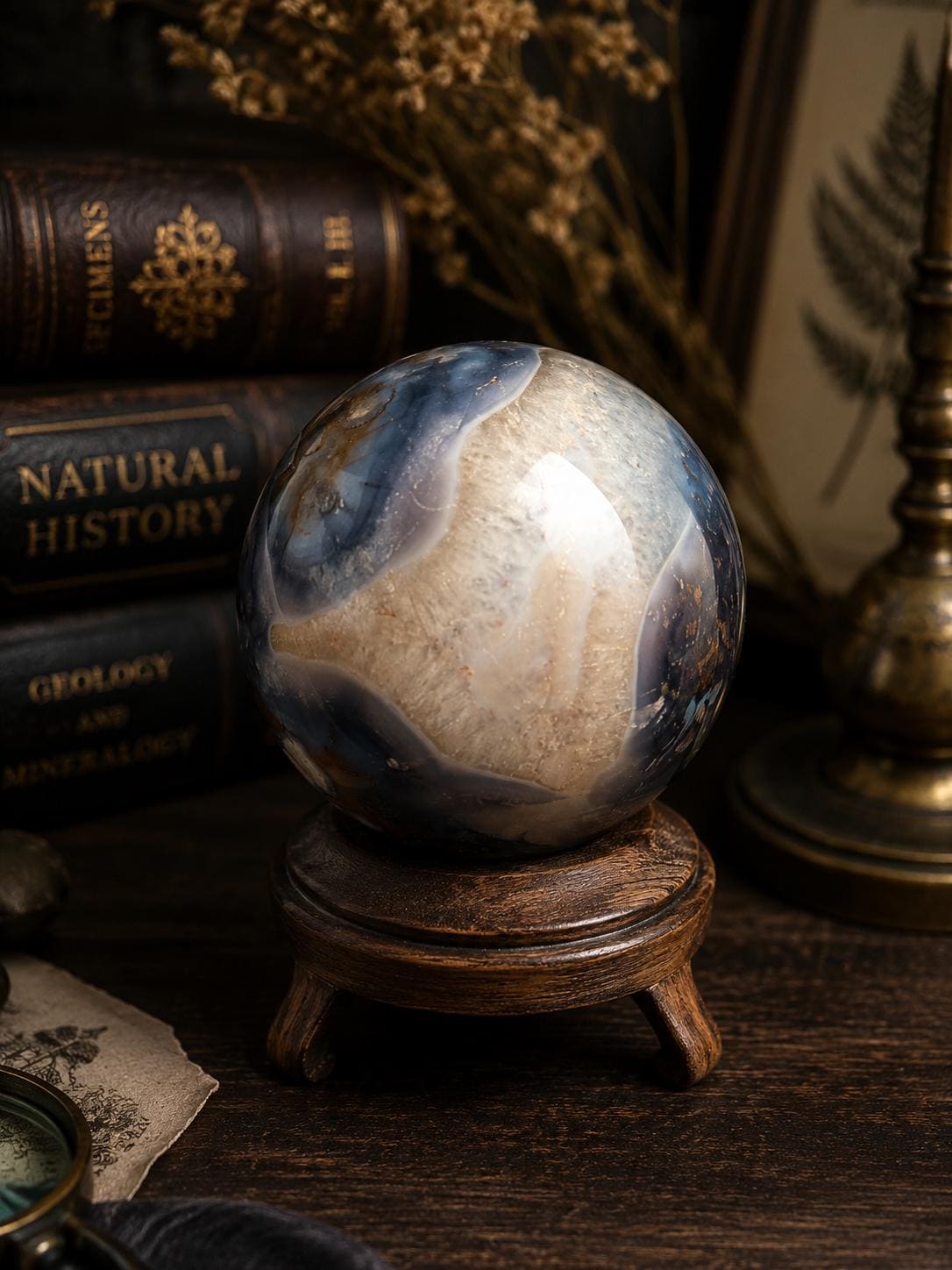
Flower agate is a very new arrival — pink-and-peach chalcedony (SiO₂) that surfaced in Madagascar around 2018, its soft base scattered with opaque white plumes that really do look like blossoms suspended mid-bloom. Those “flowers” are three-dimensional sprays of chalcedony that nucleated and grew outward inside the translucent base as silica-rich fluids filled volcanic cavities. The name is a modern trade name — not an old mineral species — and the blooms are entirely natural.
Traditionally flower agate is associated with growth, gentle blossoming, and the courage to let a dream open on its own schedule. I think of it as a stone for people planting something — a business, a season, a self — and learning to be patient with the bud.
How flower agate forms
Flower agate is chalcedony — the same fine-grained, cryptocrystalline quartz (SiO₂) as its cousins — but it does something the others don’t: it blooms. Inside a soft, translucent pink base, opaque white plumes fan outward in little three-dimensional sprays that look, uncannily, like blossoms suspended mid-open. Those “flowers” aren’t inclusions dropped in from elsewhere; they’re chalcedony too, nucleated at scattered points and grown outward as silica-rich fluids slowly filled cavities in volcanic host rock. Each bloom is a record of where the silica decided to gather.
The gentle pink-and-peach base comes from trace iron and manganese oxides picked up during crystallization — a stable, built-in color rather than anything added. And it’s tough enough for daily life: 6.5–7 on the Mohs scale, water-safe, easy to keep.
Now the honesty note, because it matters here: “flower agate” is a modern trade name, not an old mineral species. The material only surfaced in Madagascar around 2018, which makes it one of the newest stones on my shelves. You’ll sometimes meet the exact same stone under the name “cherry blossom agate.” None of that makes it less lovely — I just never want you buying a story that isn’t true. The blooms are real; the name is young.
A little history & folklore
Because flower agate is barely a handful of years old in the trade, it has no ancient legend, and I won’t hand you one. What it has is a folklore that grew up with it — and honestly, that’s its own kind of magic to watch happen. From the moment those plume-filled stones hit gem shows, crystal keepers reached for the obvious metaphor: a stone with flowers frozen mid-bloom became the stone of becoming.
So its modern reputation is all about growth on its own timeline — planting a seed, tending a bud, trusting the bloom to arrive when it’s ready. New stone, new tradition, honestly labeled.
Working with flower agate
Traditionally flower agate is associated with growth, blossoming, and gentle, patient becoming. How I use it:
- Kept near a project in its early days — a business, a garden, a new season of yourself — as a small daily reminder that buds take their time.
- Held in quiet moments when you’re tempted to force something that only wants tending, not shoving.
- Paired with moss agate, the great stone of slow growth, or rose quartz when the growing needs extra tenderness toward yourself.
My flower agate pieces are one-of-a-kind and ship with their own Flower Agate spell scroll — a little permission to bloom slowly.
Caring for your flower agate
☾ Water-safe and durable (6.5–7 on the Mohs scale). The pink comes from trace iron and manganese and is stable, but like most soft-hued stones it’s happiest with moonlight over long, harsh sun.