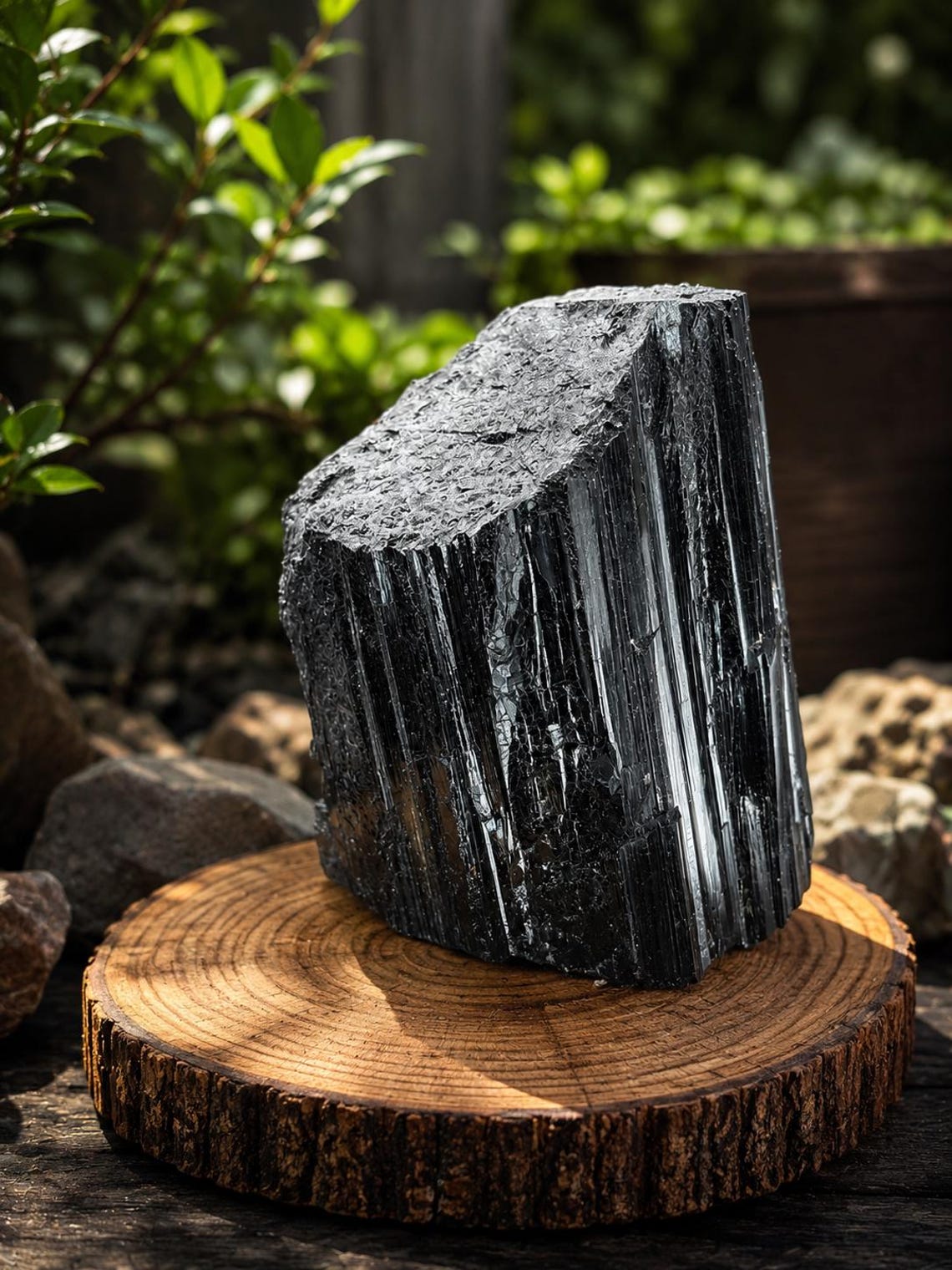
Black tourmaline — mineralogists call this variety schorl — grows in deeply striated columns that look hand-carved, though the earth did it alone. It has a genuinely strange talent: warm it or press it and it develops a small electrical charge (a property called pyroelectricity), which fascinated scientists for centuries — Dutch traders once used warmed tourmaline to pull ash from their pipes.
No stone gets reached for more often for protection. It’s traditionally associated with grounding, shielding your space, and holding a boundary without hardening your heart — the classic piece for a doorway, a desk, or the corner of a bedroom.
How black tourmaline forms
Black tourmaline — the variety mineralogists call schorl — crystallizes in pegmatites and granites, growing long, deeply striated columns wherever boron-rich fluids meet iron. The iron is what turns this member of the famously rainbow tourmaline family its bottomless velvet black, and the striations — parallel grooves running the crystal’s whole length — make raw pieces look carved, fluted, architectural. The earth does its best Gothic work in this stone.
Its strangest property is electrical. Warm a tourmaline crystal, or squeeze it, and its ends develop opposite charges — pyroelectricity and piezoelectricity. Eighteenth-century Dutch traders knew tourmaline as aschentrekker, the “ash-puller,” because warmed crystals visibly attracted ash from their pipes. A stone whose folklore says it draws in negativity has been physically, measurably pulling things toward itself in laboratory conditions for three hundred years. I’m not saying the traditions knew — I’m saying the coincidence is delicious.
A little history & folklore
The name schorl is old German mining vocabulary, likely from a Saxon village where the black crystals turned up in tin workings — miners knew this stone centuries before science sorted the tourmaline family out. “Tourmaline” itself comes from Sinhalese turamali, “mixed gems,” the catch-all label on parcels from Sri Lanka.
Across modern traditions, black tourmaline holds one office and holds it firmly: chief of protection. Folk practice places it at doorways and property corners, in pockets for crowded days, and beside beds for heavy dreamers. Older European traditions credited it with shielding against ill-wishes and storms alike.
Working with black tourmaline
Traditionally black tourmaline is associated with protection, grounding, and boundaries that hold without hardening you. How I use it:
- At the front door — the classic sentinel post — or one piece in each far corner of a room if you want to be thorough about it (tradition calls this gridding; I call it tucking the house in).
- Carried on peopley days: airports, hospitals, family holidays. The pocket-boundary.
- Paired with smoky quartz for grounded protection, or rose quartz — the bouncer and the hostess, working the same door.
My raw black tourmaline specimens are one-of-a-kind and ship with the Black Tourmaline spell scroll. Every home deserves a threshold guardian; this is the one the whole tradition votes for.
Caring for your black tourmaline
☾ Hard and hardy — a quick rinse is fine, though raw pieces can be brittle along their ridges, so handle with some tenderness. Cleanse on soil or with smoke; it’s an earth stone through and through.