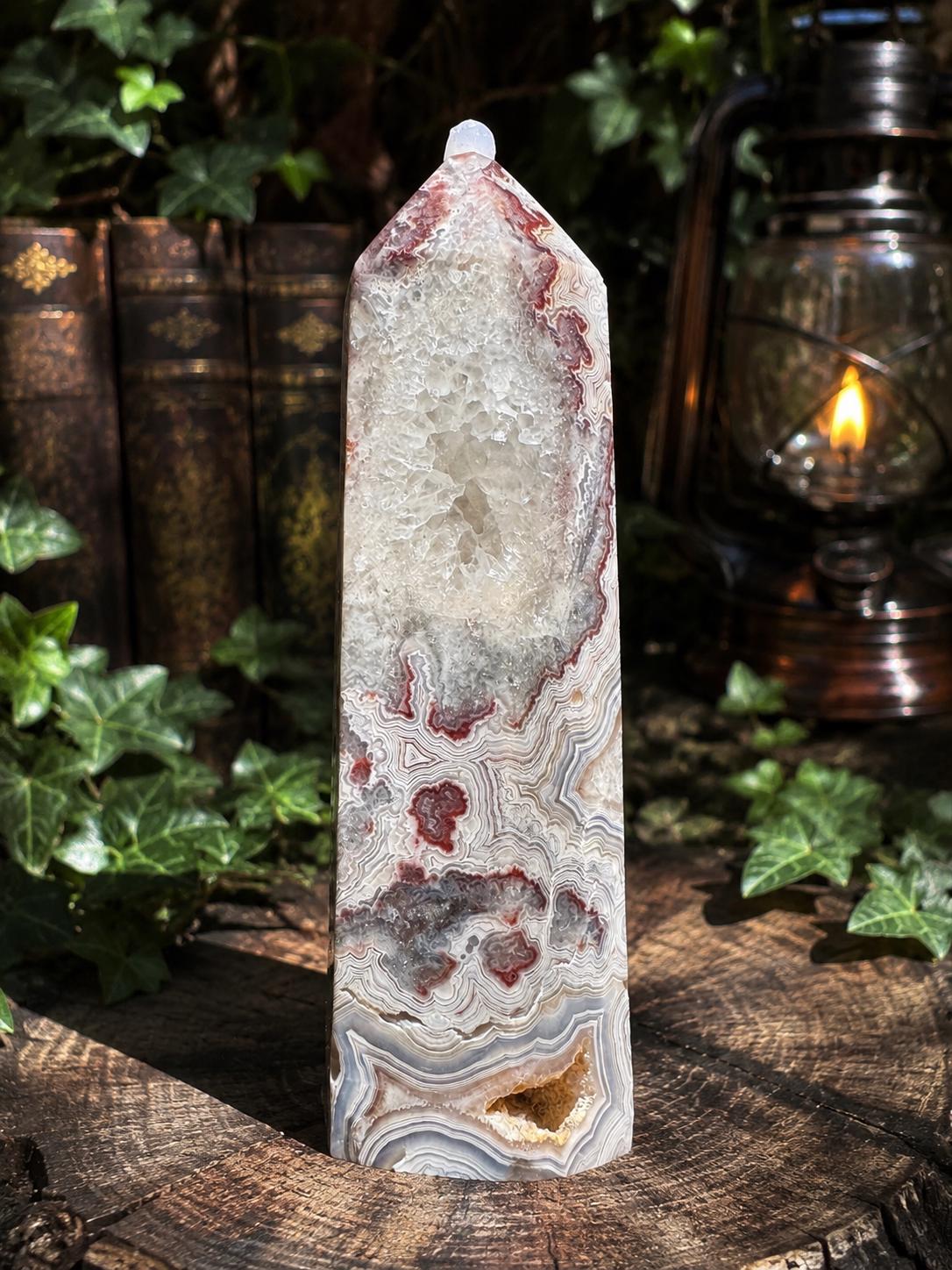
Mexican lace agate — “crazy lace” — is banded chalcedony (microcrystalline quartz) found almost entirely in one place: the state of Chihuahua in northern Mexico. Instead of the calm concentric rings most agates wear, its bands swirl, fold, and loop into paisley tangles of cream, grey, brick-red and butterscotch. Collectors nicknamed it the “laughter stone,” and once you’ve watched the pattern chase itself around a slab you understand why.
Traditionally it’s associated with joy, encouragement, and grounded high spirits — earthy warmth without the heaviness. One honest note, in my no-gatekeeping spirit: the natural palette is all earth-tones, so any electric-blue or hot-pink “crazy lace” you meet has almost certainly been dyed. Mine are the real festooned reds and creams.
How Mexican lace agate forms
Mexican lace agate is banded chalcedony — a microcrystalline variety of quartz (SiO₂) so fine-grained you can’t see the individual crystals — and it comes almost entirely from one place on earth: the state of Chihuahua in northern Mexico, in the rugged country near the Sierra Madre. That single origin is part of its charm; unlike stones scattered across a dozen mines, this one has a hometown.
It formed the way agates do: silica-rich fluids seeping, layer by rhythmic layer, into cavities in the host rock over an immense stretch of time, tinted along the way by traces of iron and aluminum. What makes this agate special is what the banding did. Most agates lay down calm concentric rings. Crazy lace instead folds, buckles and loops its bands into convoluted, festooned tangles that sweep across the stone like lacework — no two pieces alike, the pattern chasing itself in cream, grey, brick-red and butterscotch.
An honesty note, because my whole brand is no-gatekeeping: crazy lace’s natural palette is entirely earthy. If you ever see electric-blue, hot-pink, purple or rainbow “crazy lace,” that color was almost certainly added — dyed agate is an old and common trade practice, where porous bands drink up dye and denser ones resist it. Dyeing isn’t a scandal; it’s just a fact worth knowing so you can choose with open eyes. My pieces are the real festooned reds and creams.
A little history & folklore
Crazy lace agate is a relatively modern gemstone in commerce — the Chihuahua deposits rose to popularity in the twentieth century, so it doesn’t carry an ancient named legend, and I won’t pretend otherwise. What it has earned is a wonderful nickname: the “laughter stone.” Its exuberant, chaotic patterning struck collectors as downright joyful, and the association stuck. In modern folk tradition it’s sometimes called the stone of encouragement, or the “happy lace.”
That’s the honest lineage — young in the record, but genuinely beloved for the mood its patterns put people in.
Working with Mexican lace agate
Traditionally Mexican lace agate is associated with joy, encouragement, and grounded good spirits — earthy warmth without heaviness. How I use it:
- On a desk or shelf where you want a visual mood-lift; the swirling pattern is genuinely hard to frown at.
- Held or pocketed when you need steady optimism rather than a caffeine jolt — grounding and cheer at once.
- Paired with carnelian for a warm confidence boost, or moss agate to lean into its earthy, grounding side.
My Mexican lace agate pieces are one-of-a-kind and ship with their own Mexican Lace Agate spell scroll — a little laughter, written down.
Caring for your mexican lace agate
☾ Sturdy and water-safe (6.5–7 on the Mohs scale). Natural material holds its color anywhere; if you ever own a dyed piece, keep that one out of strong sun and harsh cleaners.