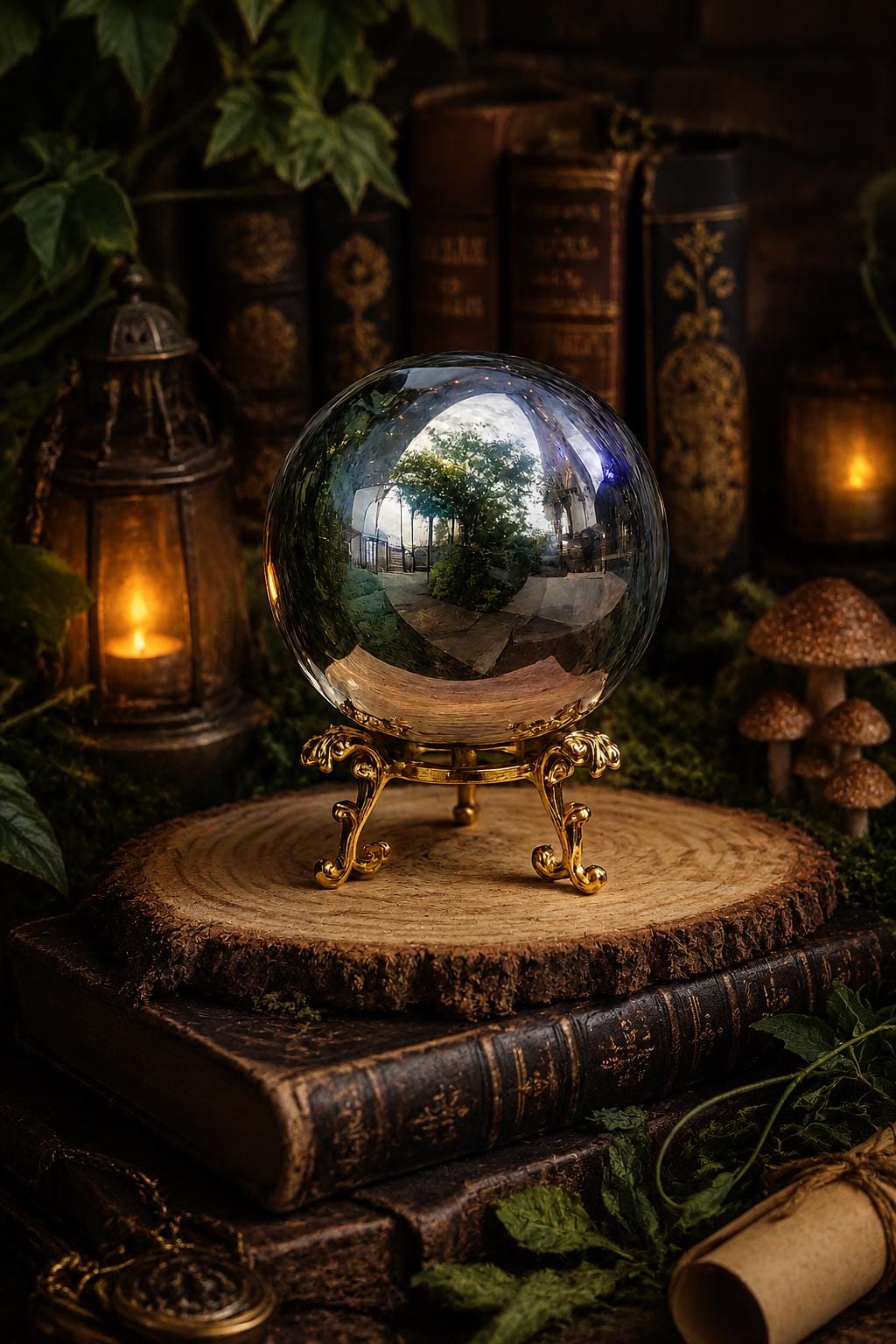
I’ll tell you up front, because that’s how we do things here: the metallic silica spheres I carry are lab-formed, not pulled from the ground. Silica itself is simply silicon dioxide — the most common compound in the earth’s crust, the stuff of quartz and sand and window glass — but these mirror-bright, silver-grey orbs are made in a workshop (the material was first developed in Japan and is often sold as “terahertz”). I keep it for its beauty, its symbolism, and its unapologetically modern edge, not for any ancient origin story it doesn’t have.
With no old folklore to inherit, silica has picked up a thoroughly contemporary set of associations: focus, mental clarity, and cool-headed reflection — fitting for a stone that literally shows you your own face. I love it on an altar as a piece of honest modern magic, a reminder that wonder doesn’t have to be old to be real.
How silica forms
Here’s where I have to be a little different from the rest of the library, because honesty is the whole brand: the metallic silica spheres I carry aren’t a mineral I can send you to a mountain for. They’re lab-formed. Silica itself — silicon dioxide, SiO₂ — is the most abundant compound in the earth’s crust; it’s the quartz in granite, the grain in a sand dune, the pane in your window. But these mirror-bright, silver-grey orbs are made in a workshop, fused and polished from silicon-rich material rather than grown underground.
The material was first developed in Japan and is widely sold under the trade name “terahertz.” It’s dense, hard (around a 7 on the Mohs scale), an excellent conductor of heat, and it takes a polish so clean the surface behaves like a true mirror. Because it’s manufactured, there’s no locality to name and no two-of-a-kind inclusion story — what you get instead is uniformity and shine, a thoroughly modern object wearing an ancient element’s name.
A little history & folklore
There’s no old legend here, and I won’t invent one for you. Silica in this polished, metallic form is a twenty-first-century creation — it entered the crystal world through the bead and sphere trade only in the last decade or so, marketed on its looks and its physics rather than any inherited myth.
What I find genuinely lovely is that its “folklore” is being written right now, in real time, by the people who keep it. That’s a rare thing to watch. Most stones arrive with centuries of meaning already attached; this one is a blank, gleaming page.
Working with silica
With no tradition to inherit, silica has gathered a modern set of associations — focus, mental clarity, and cool reflection — which suits a stone that literally shows you your own face. How I like to use it:
- As the reflective centerpiece of an altar, for scrying or simple quiet gazing.
- Set where it catches lamplight, so the room doubles inside it and the eye settles.
- Paired with clear quartz for a bright, focused pairing, or obsidian when you want two mirrors — one of light, one of shadow — side by side.
I keep silica as a piece of honest modern magic: proof that wonder doesn’t have to be ancient to be real. My metallic silica spheres are one-of-a-kind pieces and ship with their own Silica spell scroll — a little bit of the future on your shelf.
Caring for your silica (metallic sphere)
☾ Hard and durable (around a 7) with a flawless mirror polish that shows every smudge — a soft dry cloth keeps it gleaming, and a quick rinse won’t hurt it. Handle it as you would a fine sphere: it’ll chip or scuff if dropped on a hard surface, so give it a stable stand or a soft cushion to rest in.