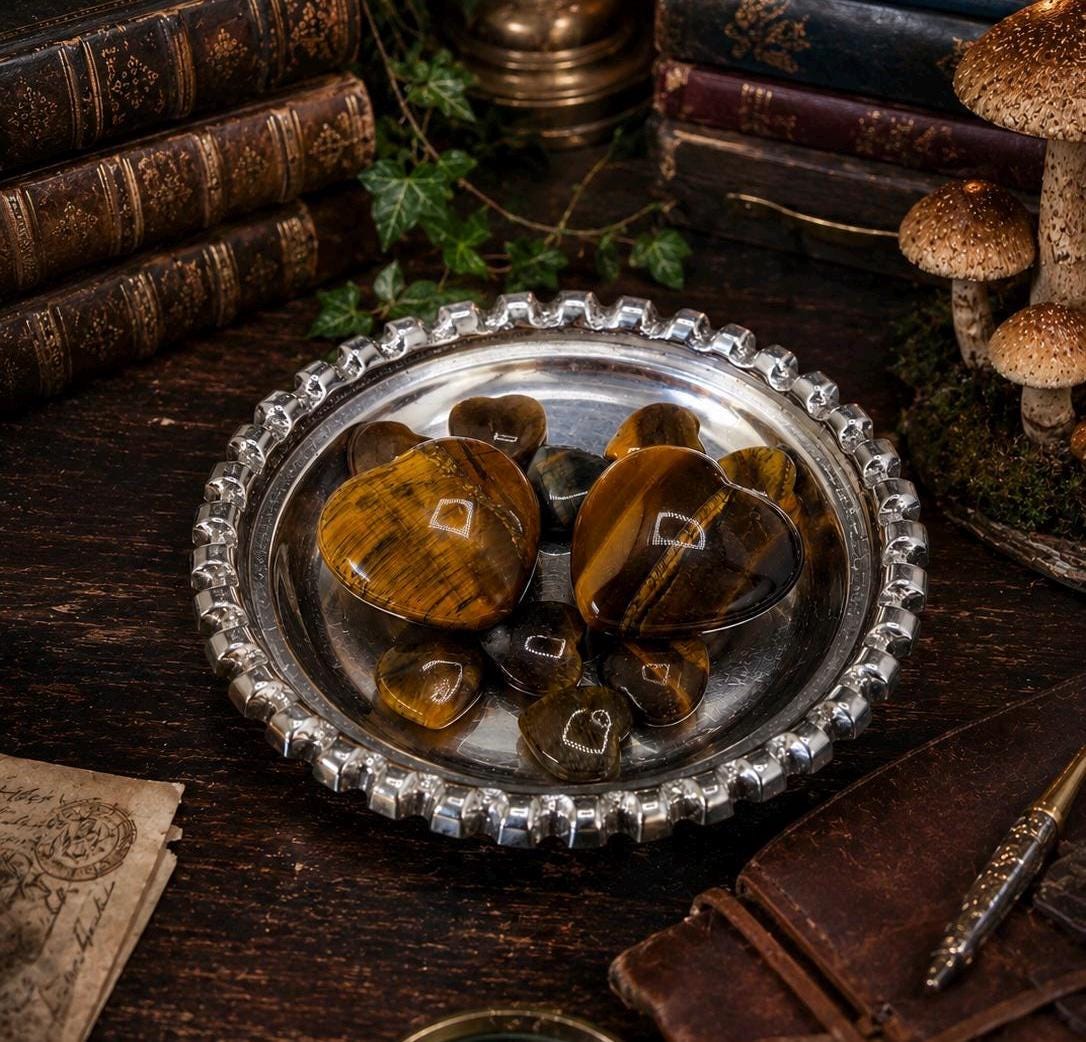
Roll tiger’s eye in the light and it moves — that flowing golden band is called chatoyancy, from the French for “cat’s eye.” Roman soldiers carried it into battle; I mostly carry it into difficult conversations.
It’s traditionally associated with confidence, courage, and keeping your head when everything is loud. Our little tiger’s eye hearts are the shop’s favorite pocket stone for exactly that.
How tiger’s eye forms
Tiger’s eye is a stone wearing another stone’s memory. It began as crocidolite — a blue, fibrous mineral — growing in fine parallel threads through ironstone in what’s now South Africa’s Northern Cape. Then, over immense time, silica-rich water dissolved and replaced those fibers with quartz, molecule by molecule, while faithfully preserving their silky, parallel structure. Iron left behind by the original mineral rusted into golds and browns, and the result is quartz that remembers being thread.
That fibrous ghost-structure is what makes the light move: turn a polished piece and a bright band glides across it — chatoyancy, the cat’s-eye effect — like sun down a bolt of silk. (Where the replacement happened before the blue faded, you get blue-gray hawk’s eye; iron-red versions are sold as bull’s eye. Same tiger, different stripes.)
A little history & folklore
The stone’s protective reputation is ancient and remarkably consistent. Roman soldiers reportedly wore engraved tiger’s eye as a talisman of bravery in battle; across various traditions it’s been treated as an all-seeing eye that watches your back — the moving band of light reads as an eye that’s awake. In the 1800s, when the South African deposits reached European markets, tiger’s eye was briefly so exotic it commanded gem prices; the Cape’s generosity eventually made it a stone anyone could own, which I count as the best kind of price crash.
Working with tiger’s eye
Traditionally tiger’s eye is associated with courage, confidence, and clear-eyed focus — bravery that thinks. How I use it:
- Carried on days you need spine and diplomacy — negotiations, difficult family dinners, asking for the raise.
- On the desk as a focus anchor: when attention drifts, find the band of light, turn the stone once, return to work.
- Paired with carnelian for boldness with ignition, or smoky quartz when courage needs grounding more than fire.
It ships with its own Tiger’s Eye spell scroll — words for the brave-and-steady kind of day.
Caring for your tiger’s eye
☾ Tough and travel-ready. Water-safe for a rinse, happy in sun or moon. Made to be carried, not shelved.