Bloodstone is deep green jasper freckled with red iron oxide, and its older name is the better one — heliotrope, from the Greek for *sun* and *to turn*. Pliny the Elder recorded the belief in the first century that a stone dropped into water would turn the sun’s reflection blood-red, which is one of my favorite pieces of ancient optics-adjacent wishful thinking. The name we use now is the plainer, more visceral one, for the obvious reason.
Traditionally bloodstone is associated with courage, endurance, and vitality — the stone of the long haul rather than the sprint. Medieval Christians carved crucifixion scenes into it and called it the martyr’s stone, and it remains one of March’s birthstones alongside aquamarine. I like it as a pocket stone on the days that ask more of you than you had budgeted for.
How bloodstone forms
Bloodstone starts as silica-rich water moving through cavities and cracks in volcanic rock. Instead of growing the big six-sided crystals quartz is famous for, the silica here crystallizes at a microscopic scale, packing into a dense mass of fibers and grains — chalcedony. Where that mass takes on enough included material to go fully opaque, we call it jasper.
The green comes from fine inclusions of chlorite-group minerals dispersed through the silica. The red comes later or alongside, as iron oxide concentrated into spots and streaks. Because the whole thing is a felted mass of tiny crystals rather than one big one, bloodstone has no cleavage and no direction of weakness at all, which is why it has been a carver’s stone for two thousand years.
Most of what reaches the market now comes out of India, where basalt country produces the classic deep green with sharp red; Brazil, Australia, and the United States contribute as well.
A little history & folklore
The ancients called it heliotrope, and Pliny the Elder mentions it in the first century as a stone used by magicians — he also relays the sun-turning-red-in-water belief that gave it the name. By late antiquity, engravers were carving it into amulets and seals.
Then the medieval Christian legend arrived and renamed it forever: that the stone formed when drops of Christ’s blood fell onto green jasper at the foot of the cross. It became the martyr’s stone, carved with crucifixion scenes throughout the Middle Ages, and there is a famous bloodstone bearing the seal of Emperor Rudolf II in the Louvre. I’ll flag this the way I always do — that’s legend, not geology. But it’s a legend that shaped what people carved into the stone for centuries, and you can still see the fingerprints of it in what bloodstone is said to mean today.
It remains one of March’s birthstones, sharing the month with aquamarine.
Working with bloodstone
Traditionally bloodstone is associated with courage, endurance, vitality, and grounded strength — the long haul rather than the sprint. How I use it:
- As a pocket stone on the days that ask more of you than you had budgeted for. It’s tough enough to live in a pocket, which not many stones are.
- At the base of a grid or in the corner of a workspace, where root-chakra stones traditionally sit.
- Paired with red jasper for pure steadiness, or carnelian when what you need is nerve rather than stamina.
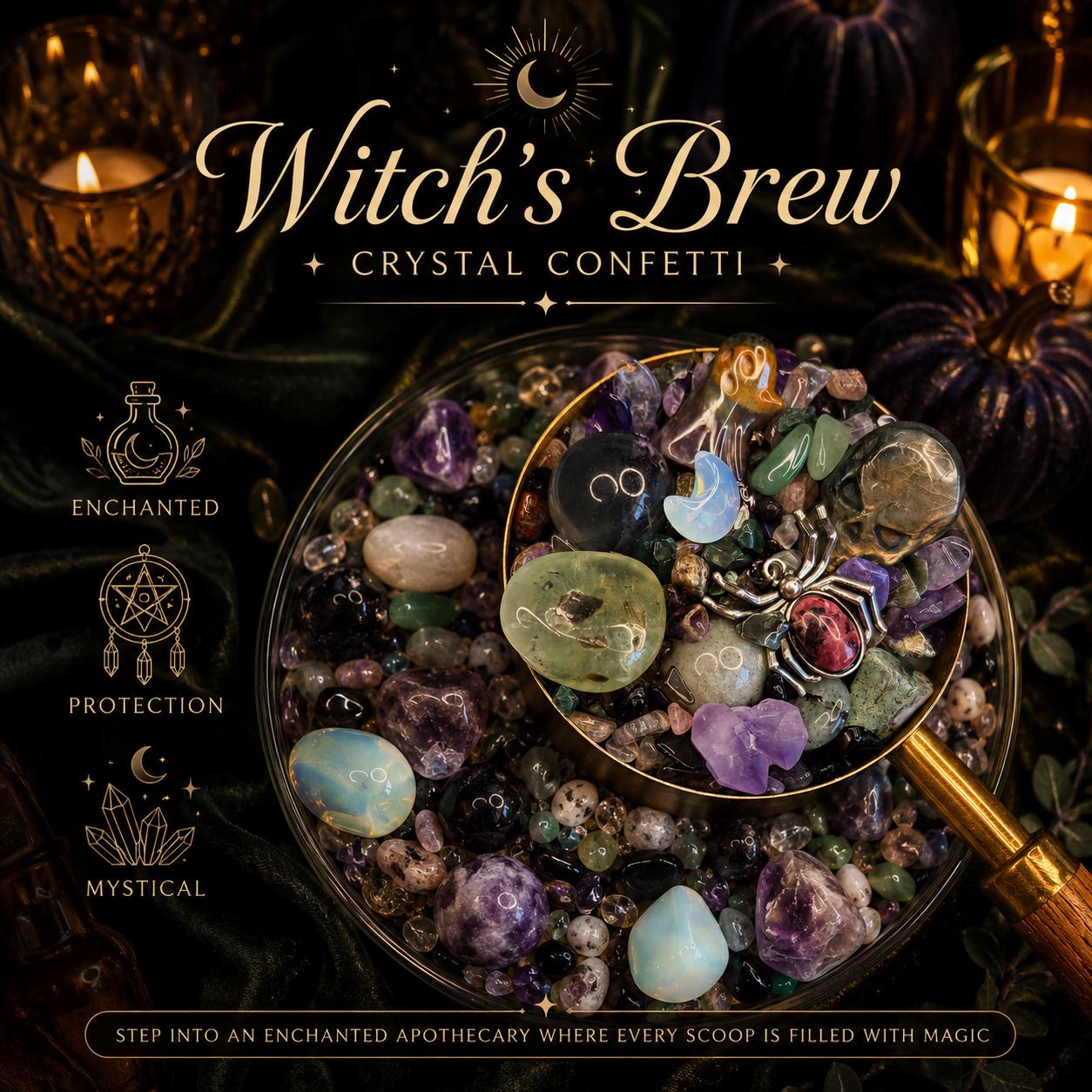
Bloodstone turns up as chips in my Witch’s Brew confetti — those tiny red-flecked greens tumbling out of a scoop are, to my eye, the most autumn thing in the whole blend.
Caring for your bloodstone
☾ Sturdy and easygoing — 6.5 to 7 on the Mohs scale, water-safe, and stable in sunlight, so a rinse and a soft cloth is all it ever asks. Cleanse it however you like. Two honest notes from the trade: a lot of what is sold as bloodstone is dyed green jasper or dyed howlite with painted-looking red flecks, so look for red that varies in tone and shape rather than identical dots; and much of the genuine material on the market today comes out of India.