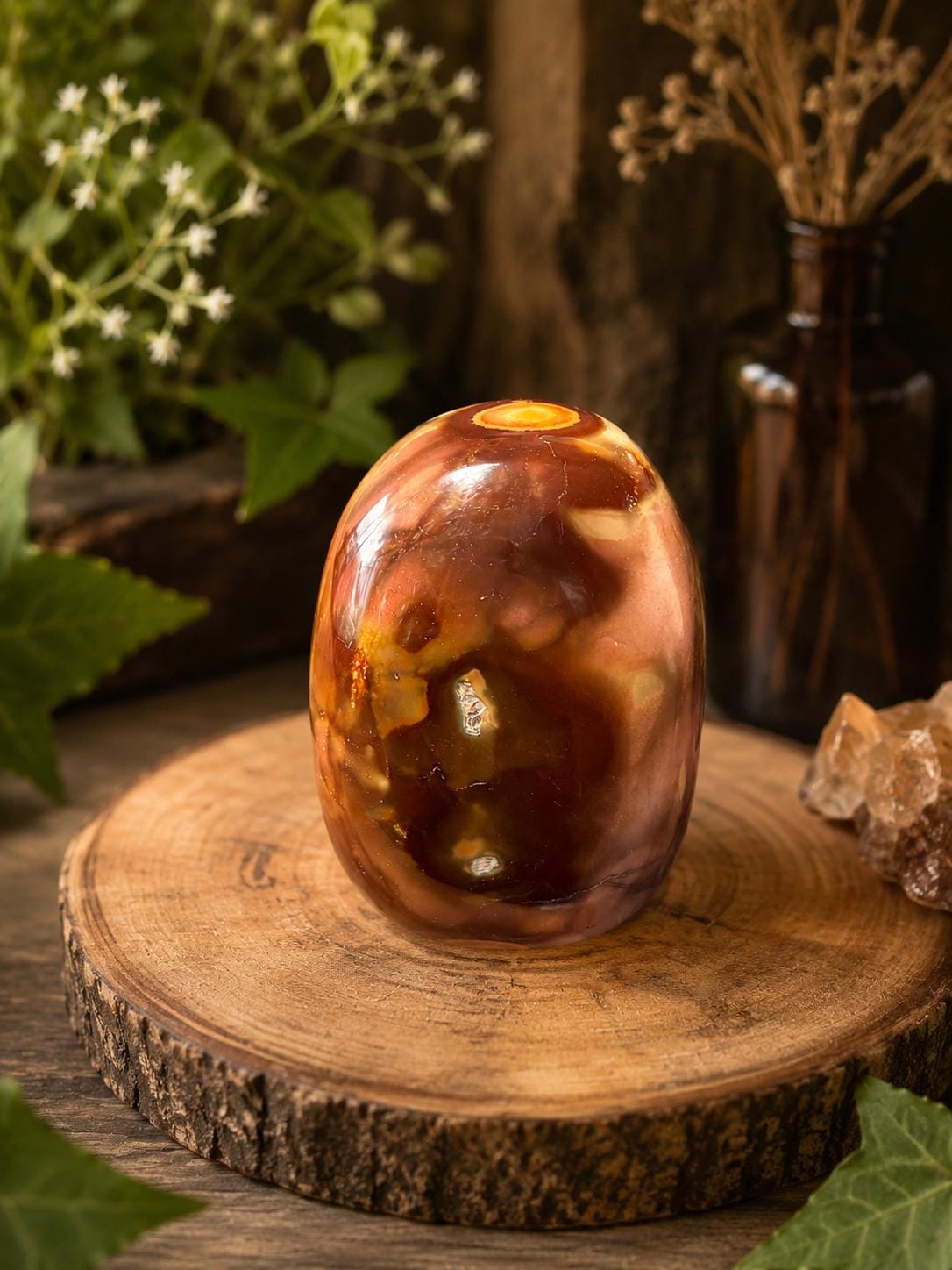
Red jasper is opaque, iron-rich chalcedony (microcrystalline quartz, SiO₂) colored a deep brick-red by finely dispersed hematite throughout the stone. It carries one of the longest documented histories of any crystal — Egyptian artisans carved it into scarabs and protective amulets for thousands of years, and the Book of the Dead specifies that the “Knot of Isis” (the Tyet, called the Blood of Isis) be made of red jasper.
Traditionally red jasper is associated with grounding, endurance, and steady protection — the “supreme nurturer” of old crystal lore, a stone for slow strength rather than sudden fire. I keep one in my pocket on days that ask me to just keep going.
How red jasper forms
Red jasper is chalcedony that went opaque and turned red. Like all jasper it’s microcrystalline quartz — silicon dioxide (SiO₂) grown in crystals too small to see — but here the silica is packed with so much finely dispersed hematite (iron oxide) that light can’t pass through it at all. The result is a dense, earthy, solid brick-red, sometimes shading to terracotta or veined with grey and cream. Because the coloring iron is spread evenly through the whole stone rather than pooled in bands, red jasper reads as one deep, saturated color instead of the layered look of its agate cousins.
That iron content also makes it wonderfully tough. At 6.5–7 on the Mohs scale, opaque, and sun-stable, red jasper is one of the most durable, low-fuss stones you can own — which is exactly why humans have been carving and carrying it since the Bronze Age. Its very name tells you what people saw: jasper comes, through Latin iaspis and Greek iaspis, from an old word meaning “spotted stone.”
A little history & folklore
Red jasper has one of the longest documented sacred histories of any stone on my shelves, and this is the part I never get tired of. In ancient Egypt it was carved into scarabs and protective amulets for thousands of years, and it was tied specifically to the goddess Isis: red jasper was named the “blood of Isis.” The Book of the Dead instructs that the Tyet — the Knot of Isis, a protective amulet meant to guard the dead through their transformation — be made of red jasper, its red standing for the goddess’s blood, power, and magic.
It didn’t stop with Egypt. Red jasper turns up as protective and strengthening amulets across Mesopotamian, Greek, Roman, and other ancient traditions — Roman seals were often cut from it. Legend held it could drive off evil and guard against snake and spider bites. (Legend, I’ll say clearly — but a very old and widespread one.) Few stones have been trusted this long.
Working with red jasper
Traditionally red jasper is associated with grounding, endurance, and steady protection — the “supreme nurturer,” a stone for slow strength rather than sudden fire. How I use it:
- Pocketed on long, demanding days as a grounding touchstone — the classic “just keep going” stone.
- Placed by a doorway or workspace where you want a steadying, protective presence, in the amulet tradition it’s carried for millennia.
- Paired with black tourmaline for a deeper protective anchor, or carnelian, its warm chalcedony cousin, when you want to add a spark of motivation.
My red jasper pieces are one-of-a-kind and ship with their own Red Jasper spell scroll — old, steady, and on your side.
Caring for your red jasper
☾ One of the toughest stones in the shop — opaque, hard (6.5–7 on the Mohs scale), water-safe, and sun-stable. A rinse is fine; avoid only long soaking, which can dull a polish over time.