Chevron amethyst is not its own mineral, and I will never pretend otherwise — it is amethyst and milky white quartz that grew in alternating layers, banded into the V-shaped arrowheads that give it the name. Every chevron is a growth record: purple where iron and natural radiation were in the water, white where they were not, stacked in order like tree rings turned sideways. You will also see the same material sold as banded, dogtooth, or phantom amethyst, depending on how the bands landed.
Traditionally chevron amethyst is associated with insight, focus, and a kind of clean mental protection — the classic amethyst associations, with the white quartz read as a brightening. I think it is one of the most underrated stones on my shelves, purely because people are looking for the solid-purple ideal and walking past a stone that tells you exactly how it was made.
How chevron amethyst forms
Every chevron is a record of conditions changing, written down in order. In a cavity or vein, quartz grew in successive layers — and the water feeding it was not the same water the whole time. When it carried trace iron, and natural radiation from the surrounding rock did its slow work on that iron, the layer came out purple. When the iron wasn’t there, the layer came out milky white or clear.
Because quartz crystallizes as pointed, six-sided terminations, those alternating layers wrap the growing crystal tips like coats of paint on an arrowhead. Cut or break the mass across those layers and you expose them in cross-section as nested Vs — the chevrons. Tilt the same specimen and you may see them as stripes instead. It’s tree rings, essentially, except the tree was a crystal and the seasons were chemical.
That purple, incidentally, is a genuinely fragile achievement. The color center that makes amethyst amethyst can be undone by light or heat — which is the whole reason for the sunlight warning, and also the reason a great deal of commercial citrine is simply amethyst that has been heated on purpose.
A little history & folklore
Chevron amethyst has no ancient legend of its own, because for most of history nobody separated it out — it was simply amethyst, and it inherits that stone’s very long story wholesale. The Greeks named amethyst amethystos, not drunken, and carved wine cups from it in the hope the stone would keep them sober; medieval bishops wore it; it sat among the most prized gems in Europe until Brazilian deposits made it abundant in the 19th century.
What chevron amethyst has instead is a modern collector’s tradition, built by people who noticed that banded material does something solid-purple material doesn’t. The white quartz reads as brightening, clearing, cutting through — so its associations tend to add focus and mental clarity to amethyst’s older calm-and-intuition inheritance.
I’ll add my own note, since modern lore is made by whoever bothers to write it down: this is the stone that shows its work. Solid amethyst gives you a result. Chevron gives you the process.
Working with chevron amethyst
Traditionally chevron amethyst is associated with insight, focused thinking, and clean mental protection — amethyst’s intuition with the white bands read as clarity. How I keep mine:
- On the desk during work that needs sustained attention, where I’d otherwise reach for clear quartz.
- Somewhere shaded but visible. Out of the sun, genuinely — but a chevron slab catching indirect light is one of the best-looking things you can put on a shelf.
- Paired with amethyst to see the family resemblance side by side, or clear quartz to lean into the bright end of it.
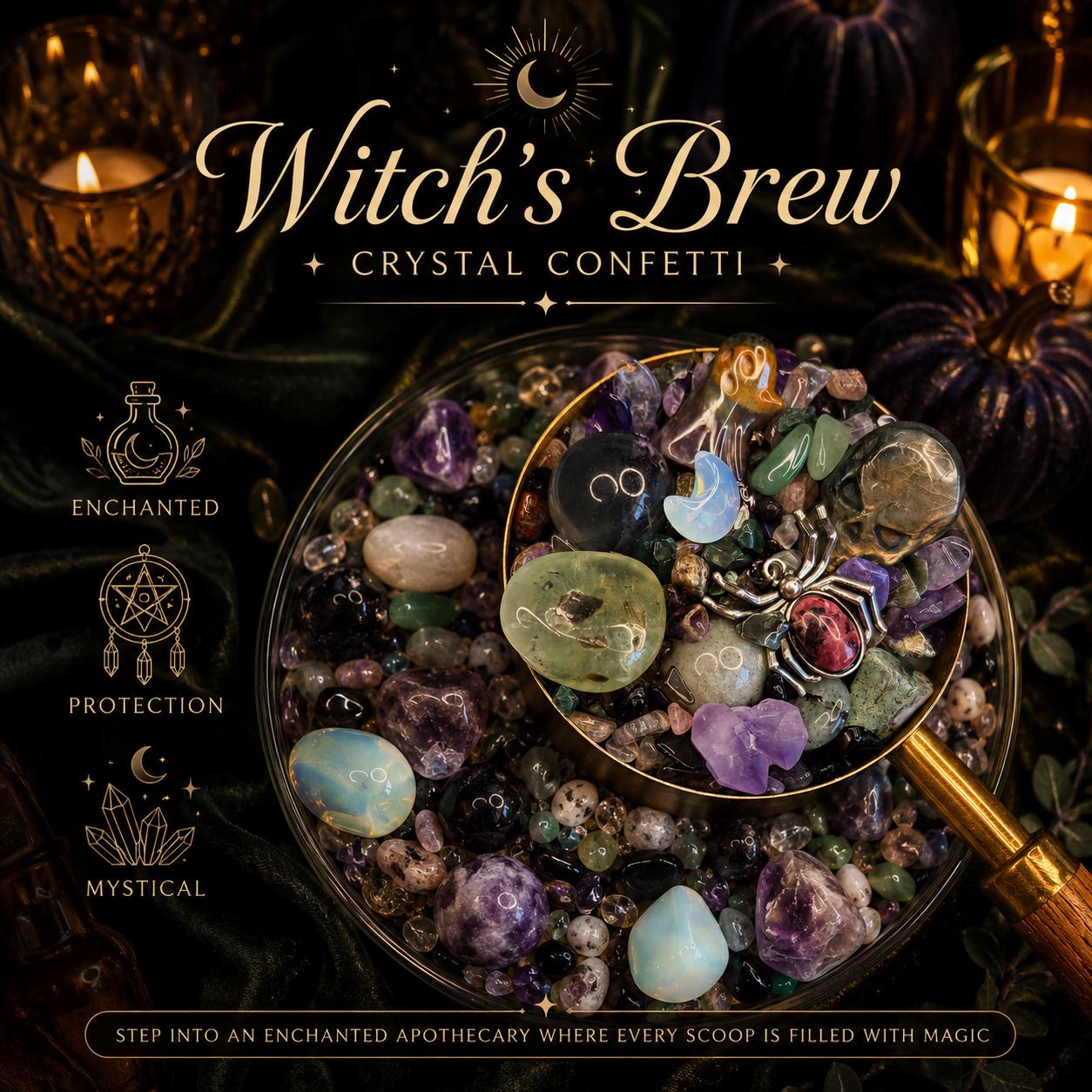
Chevron amethyst arrives in my Witch’s Brew confetti as little banded chips, and it is always the one I hold up to the light before I seal the bag — every chip a different slice through the same slow story.
Caring for your chevron amethyst
☾ Easy — it is quartz through and through, a 7 on the Mohs scale and safe to rinse. The one real rule is the same as for all amethyst: keep it out of prolonged direct sunlight, because the purple is a light-sensitive color center and it will fade to grey or yellow-brown over time. Moonlight is its friend. Fun corollary — deliberately heating amethyst is how a great deal of commercial citrine is made.